Who Is This Course For?
This course is designed for employees at all levels who participate in workplace performance reviews, development conversations or career planning discussions.
It is particularly valuable for employees who:
• are preparing for an upcoming performance review;
• are unsure what evidence to bring to a review;
• find it difficult to explain their achievements and contribution;
• want to respond more effectively to constructive or unexpected feedback;
• disagree with a performance rating or expectation and need to respond professionally;
• want to discuss development, promotion, career progression or remuneration;
• are experiencing difficult or formal performance conversations; or
• want to take greater ownership of their professional growth and future career.
For organisations, the course can be deployed across the workforce to help employees arrive at performance conversations better prepared, more reflective and ready to participate constructively.
What Capability Will Learners Develop?
By the end of the course, learners should be better able to:
Prepare for meaningful performance conversations.
Understand their role, expectations, priorities and standards; identify evidence of performance; reflect on strengths and development needs; and arrive prepared to discuss their contribution.
Participate constructively in performance discussions.
Communicate achievements professionally, ask useful questions, discuss barriers and resources, respond to feedback, manage emotional reactions and raise disagreement appropriately.
Turn performance feedback into professional growth.
Identify capability gaps, establish development priorities, create meaningful development goals and take greater ownership of their longer-term professional capability and career direction.
See Performance Conversations in Practice
Knowing what you should say during a performance conversation is different from knowing how to say it when you are sitting across from your manager.
The course includes a practical video series built around realistic performance review situations.
Learners see how different responses can change the direction of a conversation—including responses that can create defensiveness or misunderstanding and alternative approaches that demonstrate professionalism, confidence and constructive self-advocacy.
These scenarios help bridge the gap between knowing what good communication looks like and being able to use it when the conversation matters.
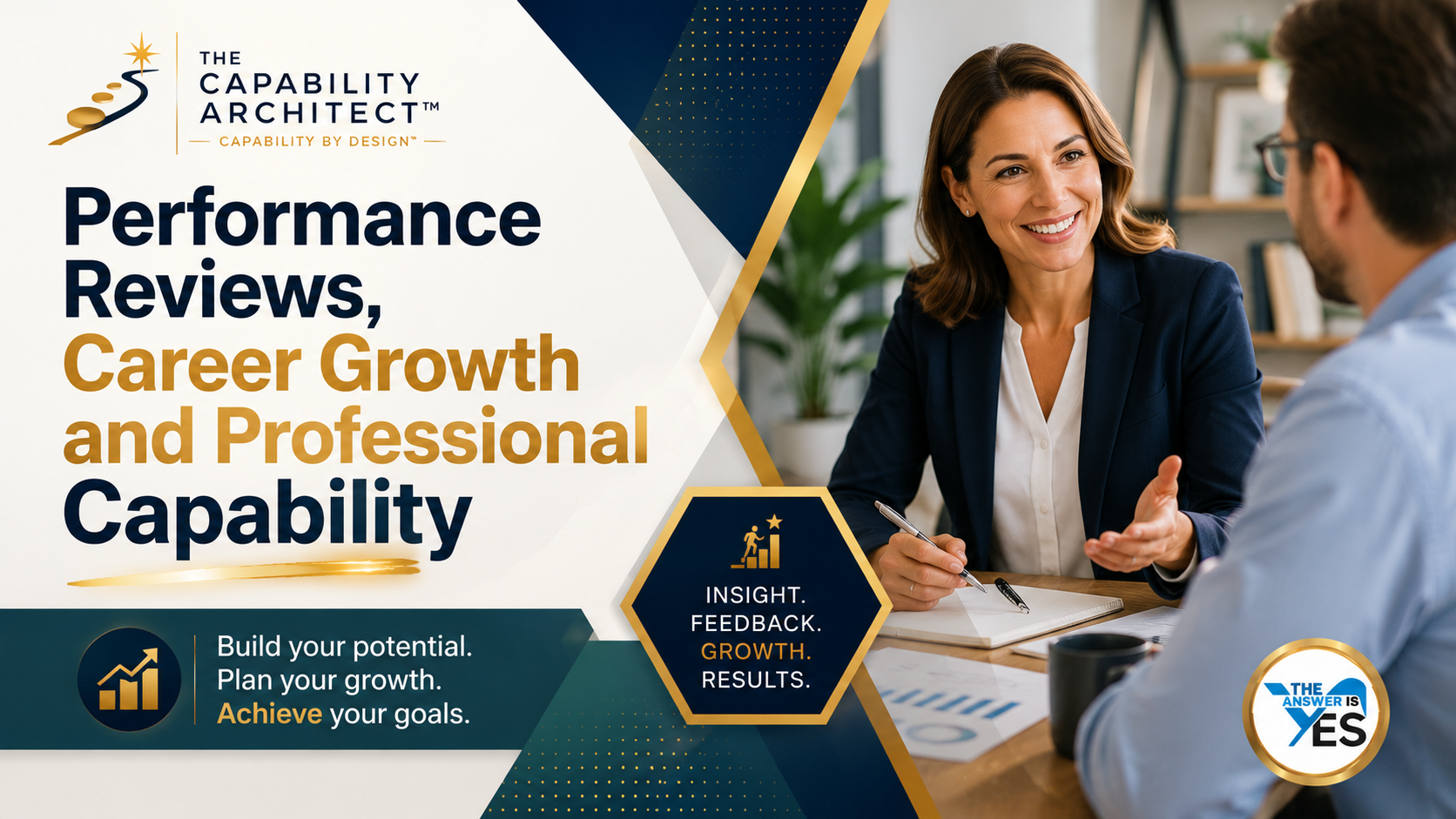
Performance Reviews, Career Growth and Professional Capability
Prepare for Better Performance Conversations—and Take Greater Ownership of Your Career
Performance reviews should be more than an annual meeting, a rating or a conversation you simply hope goes well.
Performance Reviews, Career Growth and Professional Capability helps employees understand what is expected of them, prepare meaningful evidence of their contribution, participate confidently in performance conversations, respond professionally to feedback and turn those conversations into practical development and career action.
Rather than teaching people how to simply “get through” a performance review, this course develops the capability to participate actively and constructively in the performance process—before, during and after the review.
Learners explore their role, expectations, achievements, evidence, development needs and career direction while building practical strategies they can continue using throughout their working life.
Suitable for individual professional development or organisation-wide deployment ahead of performance review cycles.
What Problem Does This Course Address?
Performance reviews often underperform because employees have never been taught how to participate effectively in them.
An employee may arrive without evidence of their contribution. They may not understand how their role is being assessed, struggle to explain achievements without sounding boastful, become defensive when receiving unexpected feedback or leave the meeting without clear development actions.
Others may not know how to raise changed responsibilities, unclear expectations, barriers to performance, career aspirations or concerns about the performance process itself.
The result can be a performance review that becomes a retrospective rating exercise rather than a meaningful conversation about performance, capability and future growth.
This course helps change that.
It develops the employee side of the performance conversation—giving people practical ways to prepare, communicate, listen, respond, ask questions, advocate for themselves and turn feedback into action.
More Than Performance Review Preparation
A performance review is only one point in a much longer professional development cycle.
The course explores the entire journey.
Learners examine how their position description relates to the work they actually perform, how outcomes and priorities differ from lists of duties, what standards apply to their role and how professional reputation, trust and visibility influence the way their contribution is understood.
They learn how to create a Performance Evidence Folder, select useful evidence and communicate contributions that may not be easily measured.
The course also explores professional self-advocacy, career progression, promotion and remuneration conversations, as well as how to respond when feedback is difficult or unexpected.
Importantly, it does not assume every performance conversation will be comfortable. Learners explore formal performance processes, reasonable management action, workplace conflict, the difference between conflict and inappropriate conduct, support people, written performance documentation and when concerns may need to be raised through appropriate channels.
The final stages move beyond the review itself into development planning, leadership readiness, professional visibility, continuous improvement and long-term professional capability.
For Organisations: Prepare Your People for Better Performance Conversations
Performance review training often concentrates on the manager.
But the quality of a performance conversation also depends on how well the employee is prepared to participate.
Deploying this course before a performance review cycle can help employees understand what they need to prepare, collect meaningful evidence, reflect realistically on their performance, identify development priorities and think about the questions they need to ask.
Instead of arriving at the meeting waiting to hear what their manager thinks, employees can arrive ready to participate in a two-way performance and development conversation.
This can support clearer expectations, stronger performance discussions, better development planning and greater employee ownership of professional growth.
Workforce pricing is available on a sliding scale based on enrolment numbers, making organisation-wide deployment more affordable.
When Might an Organisation Use This Course?
Organisations may introduce the course when preparing for an annual performance review cycle, implementing or improving a performance development framework, experiencing inconsistent quality in performance conversations, encouraging greater employee ownership of development, introducing career or capability planning, or strengthening the connection between performance reviews and workforce development.
It can also complement manager training by developing capability on the other side of the performance conversation.
That distinction is worth making prominent on the website.
Start well before the meeting by reviewing your role, current responsibilities, priorities and previous goals, and gathering evidence of your contribution. Consider what has gone well, what has been difficult, what you have learned and where you would like to develop. Good preparation means arriving ready for a two-way conversation rather than relying on memory when your manager asks what you have achieved.
From Performance Review to Professional Capability
The strongest part of this course is what happens after the performance conversation.
Learners are encouraged to move from feedback to action by identifying capability gaps, choosing development priorities and creating an Individual Development Plan. They then consider leadership readiness, future opportunities, professional visibility and how their capability may need to deepen, broaden or change as work evolves.
The goal is not simply to perform better in one meeting.
It is to develop the capability to take greater ownership of:
your performance → your development → your professional reputation → your career → your future capability.
Performance Reviews, Career Growth and Professional Capability
Prepare for the conversation. Understand your contribution. Respond professionally. Turn feedback into action. Build capability for what comes next.