Featured Image

Risk and Compliance Capability Diagnostic

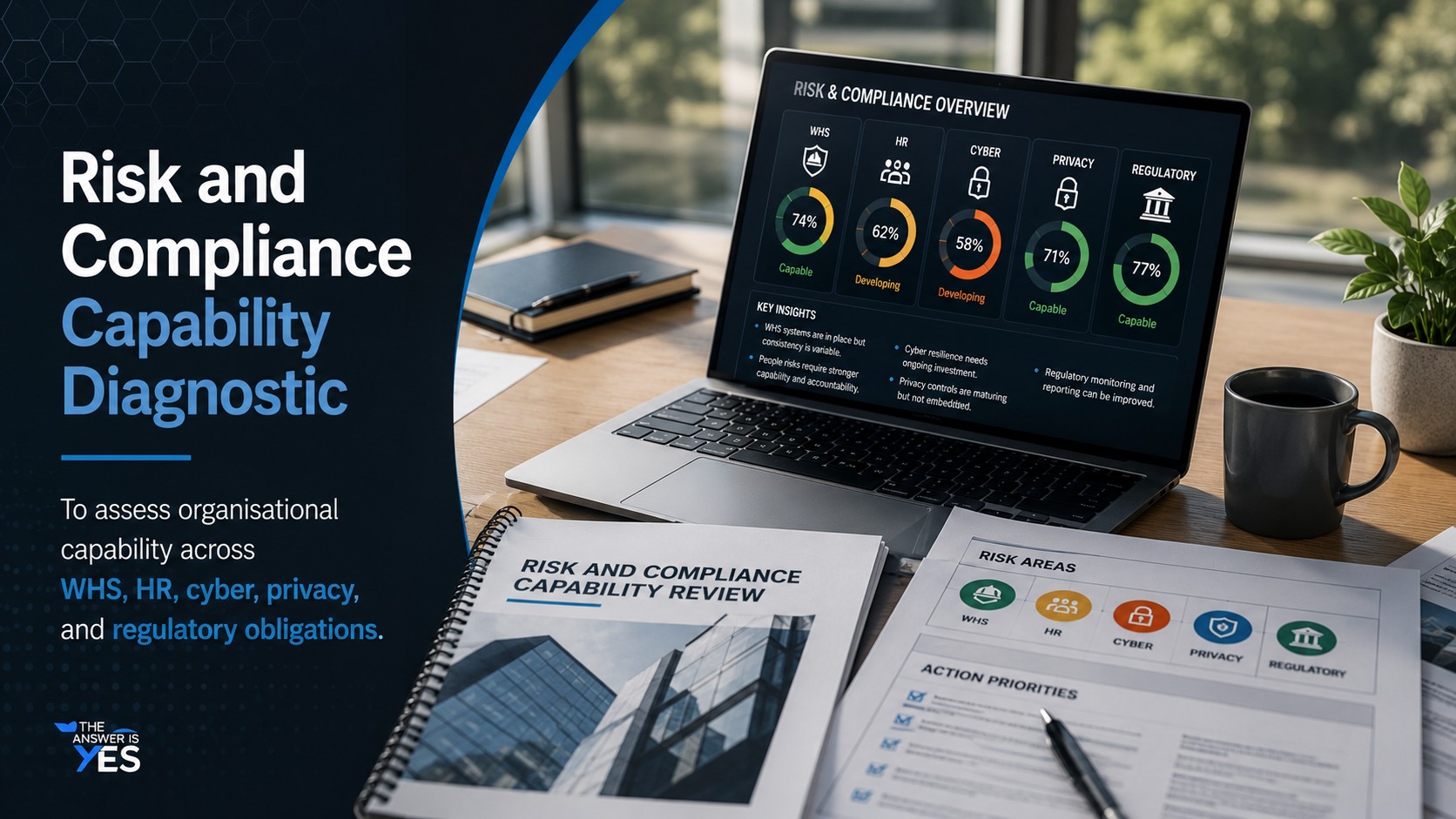
Risk and compliance diagnostic to assess organisational capability across WHS, HR, cyber, privacy, and regulatory obligations.

Risk and Compliance Capability Diagnostic

Compliance is often treated as a set of obligations that must be met. Policies are created, systems are implemented, and reporting is provided to demonstrate that requirements are in place.

The challenge is not whether compliance exists.

It is whether compliance is operating consistently across all areas of the organisation.

When you look beyond documentation, variation begins to appear. Some areas maintain strong controls and clear accountability, while others rely on informal practices or individual knowledge. Requirements may be understood at a high level, although not always applied in the same way across teams.

That variation is where risk begins to accumulate.

Why This Diagnostic Matters

Compliance does not sit within a single function. It spans workplace safety, employment practices, financial obligations, cyber security, privacy, and broader regulatory requirements.

Each area carries its own risks, although the organisation experiences the impact as a whole.

When capability is strong, compliance is embedded into daily operations. Requirements are understood, controls are applied consistently, and accountability is clear.

When capability is weaker, compliance becomes reactive, fragmented, and dependent on specific individuals to maintain standards.

Over time, this creates exposure.

The organisation may appear compliant, although gaps exist beneath the surface that are not always visible until an issue arises.

What This Actually Looks Like

Policies may be in place, although they are not always followed consistently.

Some teams operate with clear understanding of obligations, while others rely on interpretation or past practice.

In certain areas, compliance is actively monitored and enforced. In others, it is assumed to be in place without regular validation.

Reporting may indicate that requirements are met, although underlying behaviours do not always align.

As a result, compliance becomes uneven.

The organisation meets obligations in some areas while carrying risk in others.

What This Diagnostic Will Show You

This diagnostic provides a structured view of how risk and compliance capability operates across your organisation.

It examines how obligations are understood, applied, monitored, and enforced across multiple domains.

You will see where compliance is embedded, where reliance on individuals exists, and where gaps may expose the organisation to risk.

In addition, it highlights how consistency, accountability, and oversight influence overall compliance capability.

Each area reflects what is happening in practice rather than what is documented.

What Most Organisations Miss

Compliance is often measured by whether policies and systems exist.

In reality, capability is determined by how consistently those requirements are applied and validated.

When compliance relies on interpretation, when monitoring is inconsistent, or when accountability is unclear, gaps begin to form.

These gaps may not be visible through standard reporting.

The issue is not whether compliance frameworks are in place.

It is whether they are operating effectively across the organisation.

Before You Begin

To generate your results and provide your risk and compliance report, we need a few details.

This allows us to:

  • generate your risk and compliance diagnostic results
  • provide your results directly
  • identify key areas of risk exposure
  • recommend practical next steps aligned to your organisation