Featured Image

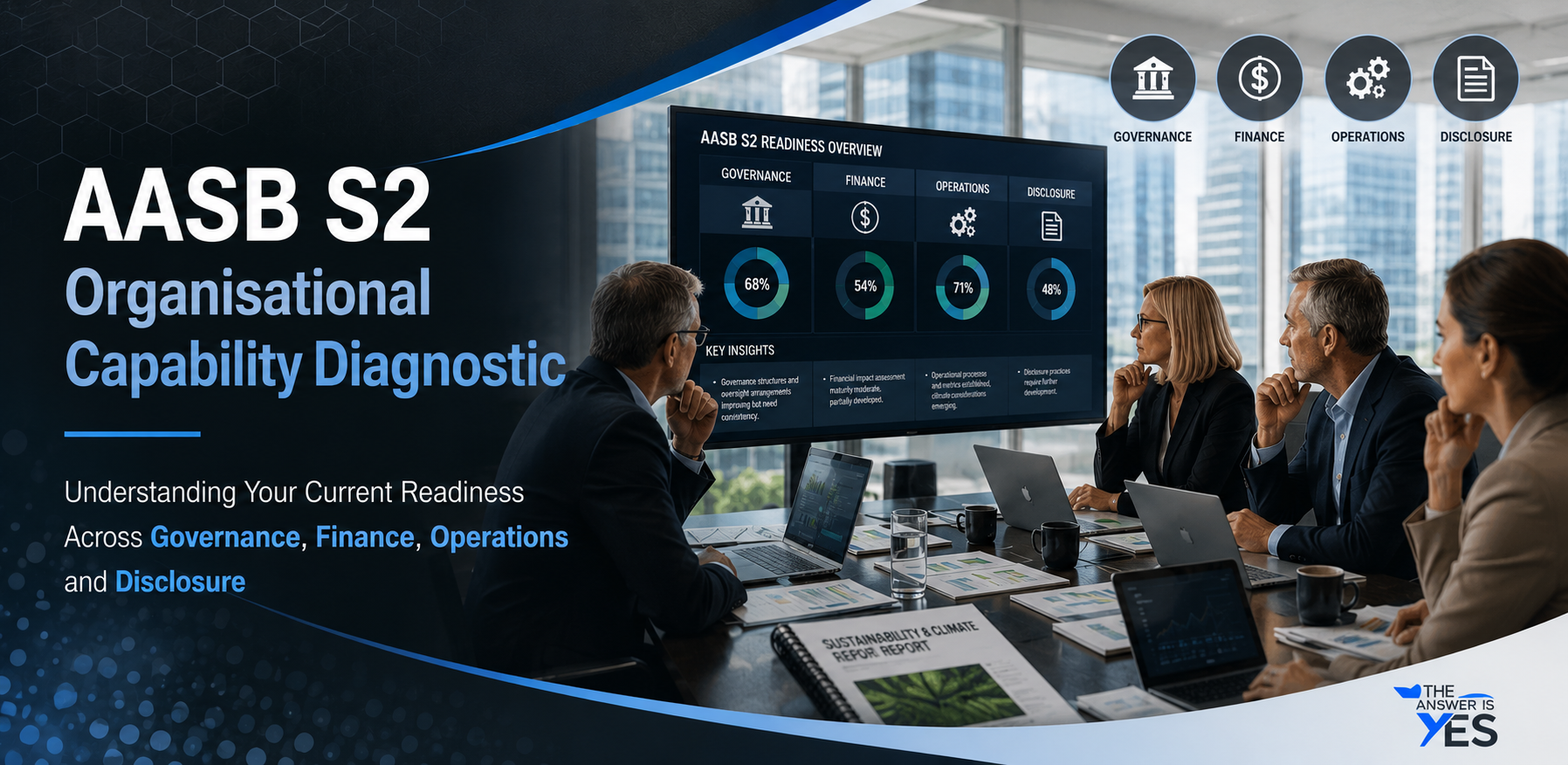
AASB S2 Organisational Capability Diagnostic

Understanding Your Current Readiness Across Governance, Finance, Operations and Disclosure

AASB S2 Organisational Capability Diagnostic

Climate-related governance, operational resilience, financial accountability, and disclosure readiness are increasingly becoming connected organisational responsibilities rather than isolated reporting activities.

Many organisations already understand that climate-related risks and opportunities matter. Governance discussions occur, operational concerns are recognised, financial implications are considered, and disclosure expectations continue to increase.

From the surface, there is often broad awareness across the organisation.

The difference appears in how consistently that awareness is connected, understood, and applied across governance, finance, operations, compliance, and decision-making.

As organisational complexity increases, variation often begins to emerge.

Different teams interpret priorities differently. Operational visibility may vary between functions. Financial assumptions may not align consistently with operational realities. Governance oversight may focus on strategic direction, although not always on how information connects across the organisation.

While the organisation may understand the issue generally, capability is not always integrated consistently.

That is where organisational exposure begins to develop.

Why This Diagnostic Matters

AASB S2 is not simply testing whether organisations can produce disclosures.
It is increasingly testing whether organisations can clearly explain:
  • where climate-related risks and dependencies sit
  • how governance oversight operates
  • how operational exposure affects the organisation
  • how assumptions support decisions
  • how disclosures connect to organisational reality
  • how accountability is maintained across functions

When organisational capability is strong, governance, finance, operations, and compliance functions operate with greater alignment and visibility. Information connects more consistently, assumptions become clearer, and decision-making becomes easier to support.

When capability is fragmented, organisations commonly experience:

  • inconsistent ownership
  • disconnected operational visibility
  • fragmented information
  • conflicting assumptions
  • inconsistent governance reporting
  • reduced disclosure confidence

Over time, these issues create organisational friction and reduce confidence in oversight, decision-making, and long-term resilience.

What This Actually Looks Like

Many organisations already hold the information they need.

However, that information often sits across:

  • different departments
  • different systems
  • different reporting structures
  • different operational perspectives

As a result, climate-related capability may become fragmented without the organisation fully recognising it.

In some situations:

  • governance oversight exists, although operational visibility remains limited
  • operational risks are understood locally, although not consistently escalated
  • finance teams recognise emerging impacts, although assumptions vary across functions
  • disclosure expectations increase, although supporting evidence remains inconsistent

Over time, these variations begin to compound.

The issue is rarely a complete absence of information.

More often, the issue is that the organisation cannot consistently connect governance, finance, operations, product, compliance, and disclosure activity into one clear organisational position.

What This Diagnostic Will Show You

This diagnostic provides a structured view of your organisation’s current capability across:

  • governance and leadership oversight
  • finance and disclosure readiness
  • operational resilience and supply chain exposure
  • product and compliance capability
  • organisational alignment and accountability

The diagnostic helps identify:

  • where capability appears strong
  • where fragmentation may exist
  • where operational exposure may sit
  • where assumptions may be inconsistent
  • where governance visibility may weaken
  • where capability pathways may require strengthening

Importantly, the diagnostic focuses on organisational reality rather than theoretical intent.

It assesses how capability operates in practice across the organisation.

What Most Organisations Miss

Capability gaps rarely appear through one major failure.

Instead, they often develop gradually through:

  • inconsistent interpretation
  • fragmented systems
  • disconnected reporting
  • operational blind spots
  • unclear ownership
  • varying assumptions
  • limited cross-functional visibility

Over time, these small variations accumulate.

Governance remains visible, although operational integration weakens.

Operational teams continue working, although risks may not be consistently escalated.

Financial assumptions continue being applied, although they may not fully reflect operational realities.

The issue is not whether climate-related capability exists somewhere inside the organisation.

The issue is whether the organisation can consistently explain how governance, operations, finance, disclosure, and accountability connect together.

Before You Begin

To generate your organisational capability results and provide your AASB S2 capability diagnostic report, we require a few details.

This allows us to:

  • generate your capability diagnostic
  • provide your results directly
  • identify relevant capability pathways
  • recommend practical next steps aligned to your organisational environment

About This Diagnostic

The AASB S2 Organisational Capability Diagnostic is designed to help organisations identify current strengths, capability gaps, and areas requiring deeper review across climate-related governance, operational resilience, financial capability, disclosure readiness, and organisational accountability.

This diagnostic does not attempt to provide legal or assurance advice.

Instead, it helps organisations understand:

  • where capability currently exists
  • where organisational exposure may sit
  • where information may be fragmented
  • where accountability may be unclear
  • where structured capability development may be required

This diagnostic forms part of The Capability Builder framework distributed through The Answer Is Yes.

How to Complete the Diagnostic

Rate each statement using the following scale:

Score Meaning
1 Not in place
2 Informal or inconsistent
3 Partially established
4 Established and applied
5 Fully embedded and evidenced

Answer based on current organisational reality rather than future intentions.