• Skip to main content
  • Skip to primary sidebar
theanswerisyes-logo

Call Us Now On

07 3180 4422

  • Home
  • Contact Us
  • Thinking
  • The Capability Gateways
    • Workforce Gateway
      • Leadership Capability
        • Emerging and Frontline Leaders
        • Communication and Influence
        • Team Leadership and Engagement Programs
        • Conflict and Difficult Conversations
        • Performance Conversations
      • People and Culture Capability
        • Workforce Foundations and HR Systems
        • Recruitment and Talent Management
        • Workplace Culture and Ethics
        • Performance and Reward Systems
      • Safety and Wellbeing Capability
        • WHS Foundations and Legal Duties
        • Psychosocial Risk and Mental Health
        • Emergency Preparedness and Response
        • Physical Risk, Chemicals and Manual Handling
        • Menopause and Life Stage Support
      • Organisational Capability
        • Governance and Structural Foundations
        • Project and Change Capability
        • Operational Systems and Process Excellence
      • Digital and Cyber Capability
        • Cyber Awareness and Human Firewall
        • Cyber Governance and Risk
        • Incident Response and Organisational Readiness
        • Secure Infrastructure and Environments
      • Career and Employability Capability
        • Career Foundations and Direction Capability
        • Job Readiness and Employability Skills Capability
        • Career Growth and Advancement
        • Career Transition and Reinvention
        • Coaching and Career Practice Capability
      • Business and Commercial Capability
        • Business Foundations and Entrepreneurship
        • Marketing, Branding and Visibility
        • Sales, Marketing and Visibility
        • Financial Intelligence and Commercial Performance
        • Strategy, Growth and Scale
      • Government Workforce Capability
    • Human Development Gateway
      • Inner Development Capability
        • Self-Leadership and Personal Mastery
        • Emotional Intelligence and Inner Resilience
        • Purpose, Meaning and Life Direction
        • Reflective Practice and Conscious Decision-Making
        • Personal Safety, Boundaries and Relational Awareness
      • Educator Development Capability
        • Instructional Design and Digital Delivery
        • Facilitation and Professional Practice
        • Professional Communication and Relational Leadership
      • Student Development Capability
        • Learning Skills and Academic Capability
        • Student Emotional Intelligence and Self-Regulation
      • Family Development Capability
        • Parenting for Learning and Development
        • Family Safety and Digital Protection
        • Healthy Family and Personal Relationships
    • First Nations Capability Gateway
    • Solopreneur Capability Gateway
  • Partner With Us
  • About
    • Our Capability Experts
    • Testimonials

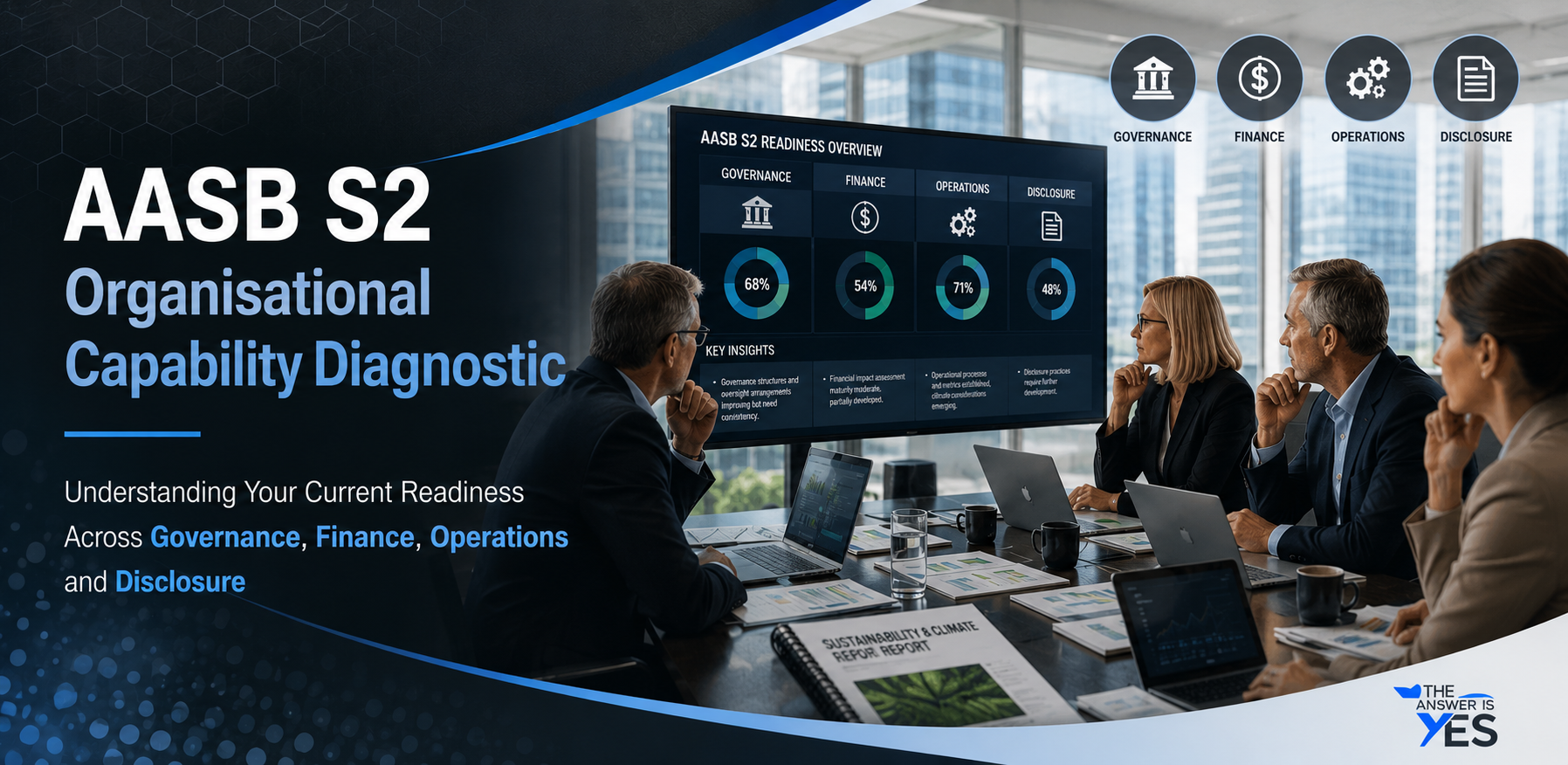
AASB S2 Organisational Capability Diagnostic

Featured Image

AASB S2 Organisational Capability Diagnostic

Understanding Your Current Readiness Across Governance, Finance, Operations and Disclosure

AASB S2 Organisational Capability Diagnostic

Climate-related governance, operational resilience, financial accountability, and disclosure readiness are increasingly becoming connected organisational responsibilities rather than isolated reporting activities.

Many organisations already understand that climate-related risks and opportunities matter. Governance discussions occur, operational concerns are recognised, financial implications are considered, and disclosure expectations continue to increase.

From the surface, there is often broad awareness across the organisation.

The difference appears in how consistently that awareness is connected, understood, and applied across governance, finance, operations, compliance, and decision-making.

As organisational complexity increases, variation often begins to emerge.

Different teams interpret priorities differently. Operational visibility may vary between functions. Financial assumptions may not align consistently with operational realities. Governance oversight may focus on strategic direction, although not always on how information connects across the organisation.

While the organisation may understand the issue generally, capability is not always integrated consistently.

That is where organisational exposure begins to develop.

Why This Diagnostic Matters

AASB S2 is not simply testing whether organisations can produce disclosures.
It is increasingly testing whether organisations can clearly explain:
  • where climate-related risks and dependencies sit
  • how governance oversight operates
  • how operational exposure affects the organisation
  • how assumptions support decisions
  • how disclosures connect to organisational reality
  • how accountability is maintained across functions

When organisational capability is strong, governance, finance, operations, and compliance functions operate with greater alignment and visibility. Information connects more consistently, assumptions become clearer, and decision-making becomes easier to support.

When capability is fragmented, organisations commonly experience:

  • inconsistent ownership
  • disconnected operational visibility
  • fragmented information
  • conflicting assumptions
  • inconsistent governance reporting
  • reduced disclosure confidence

Over time, these issues create organisational friction and reduce confidence in oversight, decision-making, and long-term resilience.

What This Actually Looks Like

Many organisations already hold the information they need.

However, that information often sits across:

  • different departments
  • different systems
  • different reporting structures
  • different operational perspectives

As a result, climate-related capability may become fragmented without the organisation fully recognising it.

In some situations:

  • governance oversight exists, although operational visibility remains limited
  • operational risks are understood locally, although not consistently escalated
  • finance teams recognise emerging impacts, although assumptions vary across functions
  • disclosure expectations increase, although supporting evidence remains inconsistent

Over time, these variations begin to compound.

The issue is rarely a complete absence of information.

More often, the issue is that the organisation cannot consistently connect governance, finance, operations, product, compliance, and disclosure activity into one clear organisational position.

What This Diagnostic Will Show You

This diagnostic provides a structured view of your organisation’s current capability across:

  • governance and leadership oversight
  • finance and disclosure readiness
  • operational resilience and supply chain exposure
  • product and compliance capability
  • organisational alignment and accountability

The diagnostic helps identify:

  • where capability appears strong
  • where fragmentation may exist
  • where operational exposure may sit
  • where assumptions may be inconsistent
  • where governance visibility may weaken
  • where capability pathways may require strengthening

Importantly, the diagnostic focuses on organisational reality rather than theoretical intent.

It assesses how capability operates in practice across the organisation.

What Most Organisations Miss

Capability gaps rarely appear through one major failure.

Instead, they often develop gradually through:

  • inconsistent interpretation
  • fragmented systems
  • disconnected reporting
  • operational blind spots
  • unclear ownership
  • varying assumptions
  • limited cross-functional visibility

Over time, these small variations accumulate.

Governance remains visible, although operational integration weakens.

Operational teams continue working, although risks may not be consistently escalated.

Financial assumptions continue being applied, although they may not fully reflect operational realities.

The issue is not whether climate-related capability exists somewhere inside the organisation.

The issue is whether the organisation can consistently explain how governance, operations, finance, disclosure, and accountability connect together.

Before You Begin

To generate your organisational capability results and provide your AASB S2 capability diagnostic report, we require a few details.

This allows us to:

  • generate your capability diagnostic
  • provide your results directly
  • identify relevant capability pathways
  • recommend practical next steps aligned to your organisational environment
1. 
Organisational priorities align with long-term resilience planning.

Governance and Leadership Capability

1 out of 55
2. 
Climate-related considerations influence organisational strategy.

Governance and Leadership Capability

2 out of 55
3. 
Governance discussions include operational and financial implications.

Governance and Leadership Capability

3 out of 55

Loading questions...

4 out of 55

Loading questions...

5 out of 55

Loading questions...

6 out of 55

Loading questions...

7 out of 55

Loading questions...

8 out of 55

Loading questions...

9 out of 55

Loading questions...

10 out of 55

Loading questions...

11 out of 55

Loading questions...

12 out of 55

Loading questions...

13 out of 55

Loading questions...

14 out of 55

Loading questions...

15 out of 55

Loading questions...

16 out of 55

Loading questions...

17 out of 55

Loading questions...

18 out of 55

Loading questions...

19 out of 55

Loading questions...

20 out of 55

Loading questions...

21 out of 55

Loading questions...

22 out of 55

Loading questions...

23 out of 55

Loading questions...

24 out of 55

Loading questions...

25 out of 55

Loading questions...

26 out of 55

Loading questions...

27 out of 55

Loading questions...

28 out of 55

Loading questions...

29 out of 55

Loading questions...

30 out of 55

Loading questions...

31 out of 55

Loading questions...

32 out of 55

Loading questions...

33 out of 55

Loading questions...

34 out of 55

Loading questions...

35 out of 55

Loading questions...

36 out of 55

Loading questions...

37 out of 55

Loading questions...

38 out of 55

Loading questions...

39 out of 55

Loading questions...

40 out of 55

Loading questions...

41 out of 55

Loading questions...

42 out of 55

Loading questions...

43 out of 55

Loading questions...

44 out of 55

Loading questions...

45 out of 55

Loading questions...

46 out of 55

Loading questions...

47 out of 55

Loading questions...

48 out of 55

Loading questions...

49 out of 55

Loading questions...

50 out of 55

Loading questions...

51 out of 55

Loading questions...

52 out of 55

Loading questions...

53 out of 55

Loading questions...

54 out of 55

Loading questions...

55 out of 55
Previous
Start Quiz Next
clock.png

Time's up

Leadership Effectiveness Diagnostic

Featured ImageFeatured Image

AASB S2 Organisational Capability Diagnostic

Understanding Your Current Readiness Across Governance, Finance, Operations and Disclosure

AASB S2 Organisational Capability Diagnostic

Climate-related governance, operational resilience, financial accountability, and disclosure readiness are increasingly becoming connected organisational responsibilities rather than isolated reporting activities.

Many organisations already understand that climate-related risks and opportunities matter. Governance discussions occur, operational concerns are recognised, financial implications are considered, and disclosure expectations continue to increase.

From the surface, there is often broad awareness across the organisation.

The difference appears in how consistently that awareness is connected, understood, and applied across governance, finance, operations, compliance, and decision-making.

As organisational complexity increases, variation often begins to emerge.

Different teams interpret priorities differently. Operational visibility may vary between functions. Financial assumptions may not align consistently with operational realities. Governance oversight may focus on strategic direction, although not always on how information connects across the organisation.

While the organisation may understand the issue generally, capability is not always integrated consistently.

That is where organisational exposure begins to develop.

Why This Diagnostic Matters

AASB S2 is not simply testing whether organisations can produce disclosures.
It is increasingly testing whether organisations can clearly explain:
  • where climate-related risks and dependencies sit
  • how governance oversight operates
  • how operational exposure affects the organisation
  • how assumptions support decisions
  • how disclosures connect to organisational reality
  • how accountability is maintained across functions

When organisational capability is strong, governance, finance, operations, and compliance functions operate with greater alignment and visibility. Information connects more consistently, assumptions become clearer, and decision-making becomes easier to support.

When capability is fragmented, organisations commonly experience:

  • inconsistent ownership
  • disconnected operational visibility
  • fragmented information
  • conflicting assumptions
  • inconsistent governance reporting
  • reduced disclosure confidence

Over time, these issues create organisational friction and reduce confidence in oversight, decision-making, and long-term resilience.

What This Actually Looks Like

Many organisations already hold the information they need.

However, that information often sits across:

  • different departments
  • different systems
  • different reporting structures
  • different operational perspectives

As a result, climate-related capability may become fragmented without the organisation fully recognising it.

In some situations:

  • governance oversight exists, although operational visibility remains limited
  • operational risks are understood locally, although not consistently escalated
  • finance teams recognise emerging impacts, although assumptions vary across functions
  • disclosure expectations increase, although supporting evidence remains inconsistent

Over time, these variations begin to compound.

The issue is rarely a complete absence of information.

More often, the issue is that the organisation cannot consistently connect governance, finance, operations, product, compliance, and disclosure activity into one clear organisational position.

What This Diagnostic Will Show You

This diagnostic provides a structured view of your organisation’s current capability across:

  • governance and leadership oversight
  • finance and disclosure readiness
  • operational resilience and supply chain exposure
  • product and compliance capability
  • organisational alignment and accountability

The diagnostic helps identify:

  • where capability appears strong
  • where fragmentation may exist
  • where operational exposure may sit
  • where assumptions may be inconsistent
  • where governance visibility may weaken
  • where capability pathways may require strengthening

Importantly, the diagnostic focuses on organisational reality rather than theoretical intent.

It assesses how capability operates in practice across the organisation.

What Most Organisations Miss

Capability gaps rarely appear through one major failure.

Instead, they often develop gradually through:

  • inconsistent interpretation
  • fragmented systems
  • disconnected reporting
  • operational blind spots
  • unclear ownership
  • varying assumptions
  • limited cross-functional visibility

Over time, these small variations accumulate.

Governance remains visible, although operational integration weakens.

Operational teams continue working, although risks may not be consistently escalated.

Financial assumptions continue being applied, although they may not fully reflect operational realities.

The issue is not whether climate-related capability exists somewhere inside the organisation.

The issue is whether the organisation can consistently explain how governance, operations, finance, disclosure, and accountability connect together.

Before You Begin

To generate your organisational capability results and provide your AASB S2 capability diagnostic report, we require a few details.

This allows us to:

  • generate your capability diagnostic
  • provide your results directly
  • identify relevant capability pathways
  • recommend practical next steps aligned to your organisational environment

Leadership Effectiveness Diagnostic

Leadership Effectiveness Diagnostic

Leadership problems rarely arrive as one clear issue. Instead, they appear through small moments that seem manageable at the time. Conversations are delayed, expectations are interpreted differently, and decisions take longer than they should. Over time, these moments shape how the team performs and how confident people feel in their roles.
Many leaders assume effort is the problem. In reality, inconsistency is usually the cause. Different leadership styles, unclear expectations, and uneven accountability create variation across teams. As a result, performance becomes difficult to manage and pressure increases across the organisation.

Why This Diagnostic Matters

Most organisations believe leadership is stronger than it is. Frameworks may exist, roles may be defined, and communication may appear clear. However, when pressure increases, those structures are tested. That is where gaps begin to show.
Expectations are applied differently across teams. Accountability depends on the individual leader. Decisions are made at different speeds and with varying levels of clarity. These differences create inconsistency, even when everyone is working hard.
Without a structured view, these patterns remain hidden. Leaders often respond by increasing their own effort rather than addressing the underlying issue. This approach is not sustainable and usually leads to increased reliance on a small number of individuals.

What This Diagnostic Will Show You

This diagnostic provides a clear view of how leadership operates in practice. It focuses on what is happening across the organisation rather than what is intended.
You will gain insight into how direction is set, how accountability is applied, and how communication influences performance. In addition, it highlights how leaders support team development and how decisions are made under pressure.
Each area reflects a different part of leadership capability. When these areas are aligned, performance becomes more consistent. When they are not, variation increases and results become harder to predict.

What Most Leaders Discover

Leadership capability is rarely even across all areas. Some leaders provide clear direction and address issues early, while others delay conversations or apply expectations differently. This creates variation in how teams operate and how outcomes are achieved.
In some parts of the business, work moves quickly because expectations are understood and decisions are made confidently. In other areas, progress slows because people wait for direction or are unsure what is expected. Over time, this imbalance increases pressure on leaders and reduces overall effectiveness.

Before You Begin

To generate your results and provide your leadership report, we need a few details. This allows us to deliver your results directly, align insights to your role, and provide the most relevant next steps for your organisation.
1. 
Organisational priorities align with long-term resilience planning.

Governance and Leadership Capability

1 out of 55
2. 
Climate-related considerations influence organisational strategy.

Governance and Leadership Capability

2 out of 55
3. 
Governance discussions include operational and financial implications.

Governance and Leadership Capability

3 out of 55

Loading questions...

4 out of 55

Loading questions...

5 out of 55

Loading questions...

6 out of 55

Loading questions...

7 out of 55

Loading questions...

8 out of 55

Loading questions...

9 out of 55

Loading questions...

10 out of 55

Loading questions...

11 out of 55

Loading questions...

12 out of 55

Loading questions...

13 out of 55

Loading questions...

14 out of 55

Loading questions...

15 out of 55

Loading questions...

16 out of 55

Loading questions...

17 out of 55

Loading questions...

18 out of 55

Loading questions...

19 out of 55

Loading questions...

20 out of 55

Loading questions...

21 out of 55

Loading questions...

22 out of 55

Loading questions...

23 out of 55

Loading questions...

24 out of 55

Loading questions...

25 out of 55

Loading questions...

26 out of 55

Loading questions...

27 out of 55

Loading questions...

28 out of 55

Loading questions...

29 out of 55

Loading questions...

30 out of 55

Loading questions...

31 out of 55

Loading questions...

32 out of 55

Loading questions...

33 out of 55

Loading questions...

34 out of 55

Loading questions...

35 out of 55

Loading questions...

36 out of 55

Loading questions...

37 out of 55

Loading questions...

38 out of 55

Loading questions...

39 out of 55

Loading questions...

40 out of 55

Loading questions...

41 out of 55

Loading questions...

42 out of 55

Loading questions...

43 out of 55

Loading questions...

44 out of 55

Loading questions...

45 out of 55

Loading questions...

46 out of 55

Loading questions...

47 out of 55

Loading questions...

48 out of 55

Loading questions...

49 out of 55

Loading questions...

50 out of 55

Loading questions...

51 out of 55

Loading questions...

52 out of 55

Loading questions...

53 out of 55

Loading questions...

54 out of 55

Loading questions...

55 out of 55
56. 
Leaders clearly communicate expectations?

Direction and Expectations

1 out of 26
57. 
Team members understand what success looks like?

Direction and Expectations

2 out of 26
58. 
Priorities are consistent across the team?

Direction and Expectations

3 out of 26

Loading questions...

4 out of 26

Loading questions...

5 out of 26

Loading questions...

6 out of 26

Loading questions...

7 out of 26

Loading questions...

8 out of 26

Loading questions...

9 out of 26

Loading questions...

10 out of 26

Loading questions...

11 out of 26

Loading questions...

12 out of 26

Loading questions...

13 out of 26

Loading questions...

14 out of 26

Loading questions...

15 out of 26

Loading questions...

16 out of 26

Loading questions...

17 out of 26

Loading questions...

18 out of 26

Loading questions...

19 out of 26

Loading questions...

20 out of 26

Loading questions...

21 out of 26

Loading questions...

22 out of 26

Loading questions...

23 out of 26

Loading questions...

24 out of 26

Loading questions...

25 out of 26

Loading questions...

26 out of 26

AASB S2 Organisational Capability Diagnostic

Understanding Your Current Readiness Across Governance, Finance, Operations and Disclosure

AASB S2 Organisational Capability Diagnostic

Climate-related governance, operational resilience, financial accountability, and disclosure readiness are increasingly becoming connected organisational responsibilities rather than isolated reporting activities.

Many organisations already understand that climate-related risks and opportunities matter. Governance discussions occur, operational concerns are recognised, financial implications are considered, and disclosure expectations continue to increase.

From the surface, there is often broad awareness across the organisation.

The difference appears in how consistently that awareness is connected, understood, and applied across governance, finance, operations, compliance, and decision-making.

As organisational complexity increases, variation often begins to emerge.

Different teams interpret priorities differently. Operational visibility may vary between functions. Financial assumptions may not align consistently with operational realities. Governance oversight may focus on strategic direction, although not always on how information connects across the organisation.

While the organisation may understand the issue generally, capability is not always integrated consistently.

That is where organisational exposure begins to develop.

Why This Diagnostic Matters

AASB S2 is not simply testing whether organisations can produce disclosures.
It is increasingly testing whether organisations can clearly explain:
  • where climate-related risks and dependencies sit
  • how governance oversight operates
  • how operational exposure affects the organisation
  • how assumptions support decisions
  • how disclosures connect to organisational reality
  • how accountability is maintained across functions

When organisational capability is strong, governance, finance, operations, and compliance functions operate with greater alignment and visibility. Information connects more consistently, assumptions become clearer, and decision-making becomes easier to support.

When capability is fragmented, organisations commonly experience:

  • inconsistent ownership
  • disconnected operational visibility
  • fragmented information
  • conflicting assumptions
  • inconsistent governance reporting
  • reduced disclosure confidence

Over time, these issues create organisational friction and reduce confidence in oversight, decision-making, and long-term resilience.

What This Actually Looks Like

Many organisations already hold the information they need.

However, that information often sits across:

  • different departments
  • different systems
  • different reporting structures
  • different operational perspectives

As a result, climate-related capability may become fragmented without the organisation fully recognising it.

In some situations:

  • governance oversight exists, although operational visibility remains limited
  • operational risks are understood locally, although not consistently escalated
  • finance teams recognise emerging impacts, although assumptions vary across functions
  • disclosure expectations increase, although supporting evidence remains inconsistent

Over time, these variations begin to compound.

The issue is rarely a complete absence of information.

More often, the issue is that the organisation cannot consistently connect governance, finance, operations, product, compliance, and disclosure activity into one clear organisational position.

What This Diagnostic Will Show You

This diagnostic provides a structured view of your organisation’s current capability across:

  • governance and leadership oversight
  • finance and disclosure readiness
  • operational resilience and supply chain exposure
  • product and compliance capability
  • organisational alignment and accountability

The diagnostic helps identify:

  • where capability appears strong
  • where fragmentation may exist
  • where operational exposure may sit
  • where assumptions may be inconsistent
  • where governance visibility may weaken
  • where capability pathways may require strengthening

Importantly, the diagnostic focuses on organisational reality rather than theoretical intent.

It assesses how capability operates in practice across the organisation.

What Most Organisations Miss

Capability gaps rarely appear through one major failure.

Instead, they often develop gradually through:

  • inconsistent interpretation
  • fragmented systems
  • disconnected reporting
  • operational blind spots
  • unclear ownership
  • varying assumptions
  • limited cross-functional visibility

Over time, these small variations accumulate.

Governance remains visible, although operational integration weakens.

Operational teams continue working, although risks may not be consistently escalated.

Financial assumptions continue being applied, although they may not fully reflect operational realities.

The issue is not whether climate-related capability exists somewhere inside the organisation.

The issue is whether the organisation can consistently explain how governance, operations, finance, disclosure, and accountability connect together.

Before You Begin

To generate your organisational capability results and provide your AASB S2 capability diagnostic report, we require a few details.

This allows us to:

  • generate your capability diagnostic
  • provide your results directly
  • identify relevant capability pathways
  • recommend practical next steps aligned to your organisational environment

Leadership Effectiveness Diagnostic

Leadership Effectiveness Diagnostic

Leadership problems rarely arrive as one clear issue. Instead, they appear through small moments that seem manageable at the time. Conversations are delayed, expectations are interpreted differently, and decisions take longer than they should. Over time, these moments shape how the team performs and how confident people feel in their roles.
Many leaders assume effort is the problem. In reality, inconsistency is usually the cause. Different leadership styles, unclear expectations, and uneven accountability create variation across teams. As a result, performance becomes difficult to manage and pressure increases across the organisation.

Why This Diagnostic Matters

Most organisations believe leadership is stronger than it is. Frameworks may exist, roles may be defined, and communication may appear clear. However, when pressure increases, those structures are tested. That is where gaps begin to show.
Expectations are applied differently across teams. Accountability depends on the individual leader. Decisions are made at different speeds and with varying levels of clarity. These differences create inconsistency, even when everyone is working hard.
Without a structured view, these patterns remain hidden. Leaders often respond by increasing their own effort rather than addressing the underlying issue. This approach is not sustainable and usually leads to increased reliance on a small number of individuals.

What This Diagnostic Will Show You

This diagnostic provides a clear view of how leadership operates in practice. It focuses on what is happening across the organisation rather than what is intended.
You will gain insight into how direction is set, how accountability is applied, and how communication influences performance. In addition, it highlights how leaders support team development and how decisions are made under pressure.
Each area reflects a different part of leadership capability. When these areas are aligned, performance becomes more consistent. When they are not, variation increases and results become harder to predict.

What Most Leaders Discover

Leadership capability is rarely even across all areas. Some leaders provide clear direction and address issues early, while others delay conversations or apply expectations differently. This creates variation in how teams operate and how outcomes are achieved.
In some parts of the business, work moves quickly because expectations are understood and decisions are made confidently. In other areas, progress slows because people wait for direction or are unsure what is expected. Over time, this imbalance increases pressure on leaders and reduces overall effectiveness.

Before You Begin

To generate your results and provide your leadership report, we need a few details. This allows us to deliver your results directly, align insights to your role, and provide the most relevant next steps for your organisation.
82. 
Organisational priorities align with long-term resilience planning.

Governance and Leadership Capability

1 out of 55
83. 
Climate-related considerations influence organisational strategy.

Governance and Leadership Capability

2 out of 55
84. 
Governance discussions include operational and financial implications.

Governance and Leadership Capability

3 out of 55

Loading questions...

4 out of 55

Loading questions...

5 out of 55

Loading questions...

6 out of 55

Loading questions...

7 out of 55

Loading questions...

8 out of 55

Loading questions...

9 out of 55

Loading questions...

10 out of 55

Loading questions...

11 out of 55

Loading questions...

12 out of 55

Loading questions...

13 out of 55

Loading questions...

14 out of 55

Loading questions...

15 out of 55

Loading questions...

16 out of 55

Loading questions...

17 out of 55

Loading questions...

18 out of 55

Loading questions...

19 out of 55

Loading questions...

20 out of 55

Loading questions...

21 out of 55

Loading questions...

22 out of 55

Loading questions...

23 out of 55

Loading questions...

24 out of 55

Loading questions...

25 out of 55

Loading questions...

26 out of 55

Loading questions...

27 out of 55

Loading questions...

28 out of 55

Loading questions...

29 out of 55

Loading questions...

30 out of 55

Loading questions...

31 out of 55

Loading questions...

32 out of 55

Loading questions...

33 out of 55

Loading questions...

34 out of 55

Loading questions...

35 out of 55

Loading questions...

36 out of 55

Loading questions...

37 out of 55

Loading questions...

38 out of 55

Loading questions...

39 out of 55

Loading questions...

40 out of 55

Loading questions...

41 out of 55

Loading questions...

42 out of 55

Loading questions...

43 out of 55

Loading questions...

44 out of 55

Loading questions...

45 out of 55

Loading questions...

46 out of 55

Loading questions...

47 out of 55

Loading questions...

48 out of 55

Loading questions...

49 out of 55

Loading questions...

50 out of 55

Loading questions...

51 out of 55

Loading questions...

52 out of 55

Loading questions...

53 out of 55

Loading questions...

54 out of 55

Loading questions...

55 out of 55
137. 
Leaders clearly communicate expectations?

Direction and Expectations

1 out of 26
138. 
Team members understand what success looks like?

Direction and Expectations

2 out of 26
139. 
Priorities are consistent across the team?

Direction and Expectations

3 out of 26

Loading questions...

4 out of 26

Loading questions...

5 out of 26

Loading questions...

6 out of 26

Loading questions...

7 out of 26

Loading questions...

8 out of 26

Loading questions...

9 out of 26

Loading questions...

10 out of 26

Loading questions...

11 out of 26

Loading questions...

12 out of 26

Loading questions...

13 out of 26

Loading questions...

14 out of 26

Loading questions...

15 out of 26

Loading questions...

16 out of 26

Loading questions...

17 out of 26

Loading questions...

18 out of 26

Loading questions...

19 out of 26

Loading questions...

20 out of 26

Loading questions...

21 out of 26

Loading questions...

22 out of 26

Loading questions...

23 out of 26

Loading questions...

24 out of 26

Loading questions...

25 out of 26

Loading questions...

26 out of 26
Previous
Start Quiz Next
Previous Previous
Start Quiz Start Quiz Next Next
clock.png

Time's up

Test Quiz for Result pages

Featured ImageFeatured ImageFeatured Image

AASB S2 Organisational Capability Diagnostic

Understanding Your Current Readiness Across Governance, Finance, Operations and Disclosure

AASB S2 Organisational Capability Diagnostic

Climate-related governance, operational resilience, financial accountability, and disclosure readiness are increasingly becoming connected organisational responsibilities rather than isolated reporting activities.

Many organisations already understand that climate-related risks and opportunities matter. Governance discussions occur, operational concerns are recognised, financial implications are considered, and disclosure expectations continue to increase.

From the surface, there is often broad awareness across the organisation.

The difference appears in how consistently that awareness is connected, understood, and applied across governance, finance, operations, compliance, and decision-making.

As organisational complexity increases, variation often begins to emerge.

Different teams interpret priorities differently. Operational visibility may vary between functions. Financial assumptions may not align consistently with operational realities. Governance oversight may focus on strategic direction, although not always on how information connects across the organisation.

While the organisation may understand the issue generally, capability is not always integrated consistently.

That is where organisational exposure begins to develop.

Why This Diagnostic Matters

AASB S2 is not simply testing whether organisations can produce disclosures.
It is increasingly testing whether organisations can clearly explain:
  • where climate-related risks and dependencies sit
  • how governance oversight operates
  • how operational exposure affects the organisation
  • how assumptions support decisions
  • how disclosures connect to organisational reality
  • how accountability is maintained across functions

When organisational capability is strong, governance, finance, operations, and compliance functions operate with greater alignment and visibility. Information connects more consistently, assumptions become clearer, and decision-making becomes easier to support.

When capability is fragmented, organisations commonly experience:

  • inconsistent ownership
  • disconnected operational visibility
  • fragmented information
  • conflicting assumptions
  • inconsistent governance reporting
  • reduced disclosure confidence

Over time, these issues create organisational friction and reduce confidence in oversight, decision-making, and long-term resilience.

What This Actually Looks Like

Many organisations already hold the information they need.

However, that information often sits across:

  • different departments
  • different systems
  • different reporting structures
  • different operational perspectives

As a result, climate-related capability may become fragmented without the organisation fully recognising it.

In some situations:

  • governance oversight exists, although operational visibility remains limited
  • operational risks are understood locally, although not consistently escalated
  • finance teams recognise emerging impacts, although assumptions vary across functions
  • disclosure expectations increase, although supporting evidence remains inconsistent

Over time, these variations begin to compound.

The issue is rarely a complete absence of information.

More often, the issue is that the organisation cannot consistently connect governance, finance, operations, product, compliance, and disclosure activity into one clear organisational position.

What This Diagnostic Will Show You

This diagnostic provides a structured view of your organisation’s current capability across:

  • governance and leadership oversight
  • finance and disclosure readiness
  • operational resilience and supply chain exposure
  • product and compliance capability
  • organisational alignment and accountability

The diagnostic helps identify:

  • where capability appears strong
  • where fragmentation may exist
  • where operational exposure may sit
  • where assumptions may be inconsistent
  • where governance visibility may weaken
  • where capability pathways may require strengthening

Importantly, the diagnostic focuses on organisational reality rather than theoretical intent.

It assesses how capability operates in practice across the organisation.

What Most Organisations Miss

Capability gaps rarely appear through one major failure.

Instead, they often develop gradually through:

  • inconsistent interpretation
  • fragmented systems
  • disconnected reporting
  • operational blind spots
  • unclear ownership
  • varying assumptions
  • limited cross-functional visibility

Over time, these small variations accumulate.

Governance remains visible, although operational integration weakens.

Operational teams continue working, although risks may not be consistently escalated.

Financial assumptions continue being applied, although they may not fully reflect operational realities.

The issue is not whether climate-related capability exists somewhere inside the organisation.

The issue is whether the organisation can consistently explain how governance, operations, finance, disclosure, and accountability connect together.

Before You Begin

To generate your organisational capability results and provide your AASB S2 capability diagnostic report, we require a few details.

This allows us to:

  • generate your capability diagnostic
  • provide your results directly
  • identify relevant capability pathways
  • recommend practical next steps aligned to your organisational environment

Leadership Effectiveness Diagnostic

Leadership Effectiveness Diagnostic

Leadership problems rarely arrive as one clear issue. Instead, they appear through small moments that seem manageable at the time. Conversations are delayed, expectations are interpreted differently, and decisions take longer than they should. Over time, these moments shape how the team performs and how confident people feel in their roles.
Many leaders assume effort is the problem. In reality, inconsistency is usually the cause. Different leadership styles, unclear expectations, and uneven accountability create variation across teams. As a result, performance becomes difficult to manage and pressure increases across the organisation.

Why This Diagnostic Matters

Most organisations believe leadership is stronger than it is. Frameworks may exist, roles may be defined, and communication may appear clear. However, when pressure increases, those structures are tested. That is where gaps begin to show.
Expectations are applied differently across teams. Accountability depends on the individual leader. Decisions are made at different speeds and with varying levels of clarity. These differences create inconsistency, even when everyone is working hard.
Without a structured view, these patterns remain hidden. Leaders often respond by increasing their own effort rather than addressing the underlying issue. This approach is not sustainable and usually leads to increased reliance on a small number of individuals.

What This Diagnostic Will Show You

This diagnostic provides a clear view of how leadership operates in practice. It focuses on what is happening across the organisation rather than what is intended.
You will gain insight into how direction is set, how accountability is applied, and how communication influences performance. In addition, it highlights how leaders support team development and how decisions are made under pressure.
Each area reflects a different part of leadership capability. When these areas are aligned, performance becomes more consistent. When they are not, variation increases and results become harder to predict.

What Most Leaders Discover

Leadership capability is rarely even across all areas. Some leaders provide clear direction and address issues early, while others delay conversations or apply expectations differently. This creates variation in how teams operate and how outcomes are achieved.
In some parts of the business, work moves quickly because expectations are understood and decisions are made confidently. In other areas, progress slows because people wait for direction or are unsure what is expected. Over time, this imbalance increases pressure on leaders and reduces overall effectiveness.

Before You Begin

To generate your results and provide your leadership report, we need a few details. This allows us to deliver your results directly, align insights to your role, and provide the most relevant next steps for your organisation.

Test Quiz for Result pages

Leadership Effectiveness Diagnostic

Leadership problems rarely arrive as one clear issue. Instead, they appear through small moments that seem manageable at the time. Conversations are delayed, expectations are interpreted differently, and decisions take longer than they should. Over time, these moments shape how the team performs and how confident people feel in their roles.
Many leaders assume effort is the problem. In reality, inconsistency is usually the cause. Different leadership styles, unclear expectations, and uneven accountability create variation across teams. As a result, performance becomes difficult to manage and pressure increases across the organisation.

Why This Diagnostic Matters

Most organisations believe leadership is stronger than it is. Frameworks may exist, roles may be defined, and communication may appear clear. However, when pressure increases, those structures are tested. That is where gaps begin to show.
Expectations are applied differently across teams. Accountability depends on the individual leader. Decisions are made at different speeds and with varying levels of clarity. These differences create inconsistency, even when everyone is working hard.
Without a structured view, these patterns remain hidden. Leaders often respond by increasing their own effort rather than addressing the underlying issue. This approach is not sustainable and usually leads to increased reliance on a small number of individuals.

What This Diagnostic Will Show You

This diagnostic provides a clear view of how leadership operates in practice. It focuses on what is happening across the organisation rather than what is intended.
You will gain insight into how direction is set, how accountability is applied, and how communication influences performance. In addition, it highlights how leaders support team development and how decisions are made under pressure.
Each area reflects a different part of leadership capability. When these areas are aligned, performance becomes more consistent. When they are not, variation increases and results become harder to predict.

What Most Leaders Discover

Leadership capability is rarely even across all areas. Some leaders provide clear direction and address issues early, while others delay conversations or apply expectations differently. This creates variation in how teams operate and how outcomes are achieved.
In some parts of the business, work moves quickly because expectations are understood and decisions are made confidently. In other areas, progress slows because people wait for direction or are unsure what is expected. Over time, this imbalance increases pressure on leaders and reduces overall effectiveness.

Before You Begin

To generate your results and provide your leadership report, we need a few details. This allows us to deliver your results directly, align insights to your role, and provide the most relevant next steps for your organisation.
1. 
Organisational priorities align with long-term resilience planning.

Governance and Leadership Capability

1 out of 55
2. 
Climate-related considerations influence organisational strategy.

Governance and Leadership Capability

2 out of 55
3. 
Governance discussions include operational and financial implications.

Governance and Leadership Capability

3 out of 55

Loading questions...

4 out of 55

Loading questions...

5 out of 55

Loading questions...

6 out of 55

Loading questions...

7 out of 55

Loading questions...

8 out of 55

Loading questions...

9 out of 55

Loading questions...

10 out of 55

Loading questions...

11 out of 55

Loading questions...

12 out of 55

Loading questions...

13 out of 55

Loading questions...

14 out of 55

Loading questions...

15 out of 55

Loading questions...

16 out of 55

Loading questions...

17 out of 55

Loading questions...

18 out of 55

Loading questions...

19 out of 55

Loading questions...

20 out of 55

Loading questions...

21 out of 55

Loading questions...

22 out of 55

Loading questions...

23 out of 55

Loading questions...

24 out of 55

Loading questions...

25 out of 55

Loading questions...

26 out of 55

Loading questions...

27 out of 55

Loading questions...

28 out of 55

Loading questions...

29 out of 55

Loading questions...

30 out of 55

Loading questions...

31 out of 55

Loading questions...

32 out of 55

Loading questions...

33 out of 55

Loading questions...

34 out of 55

Loading questions...

35 out of 55

Loading questions...

36 out of 55

Loading questions...

37 out of 55

Loading questions...

38 out of 55

Loading questions...

39 out of 55

Loading questions...

40 out of 55

Loading questions...

41 out of 55

Loading questions...

42 out of 55

Loading questions...

43 out of 55

Loading questions...

44 out of 55

Loading questions...

45 out of 55

Loading questions...

46 out of 55

Loading questions...

47 out of 55

Loading questions...

48 out of 55

Loading questions...

49 out of 55

Loading questions...

50 out of 55

Loading questions...

51 out of 55

Loading questions...

52 out of 55

Loading questions...

53 out of 55

Loading questions...

54 out of 55

Loading questions...

55 out of 55
56. 
Leaders clearly communicate expectations?

Direction and Expectations

1 out of 26
57. 
Team members understand what success looks like?

Direction and Expectations

2 out of 26
58. 
Priorities are consistent across the team?

Direction and Expectations

3 out of 26

Loading questions...

4 out of 26

Loading questions...

5 out of 26

Loading questions...

6 out of 26

Loading questions...

7 out of 26

Loading questions...

8 out of 26

Loading questions...

9 out of 26

Loading questions...

10 out of 26

Loading questions...

11 out of 26

Loading questions...

12 out of 26

Loading questions...

13 out of 26

Loading questions...

14 out of 26

Loading questions...

15 out of 26

Loading questions...

16 out of 26

Loading questions...

17 out of 26

Loading questions...

18 out of 26

Loading questions...

19 out of 26

Loading questions...

20 out of 26

Loading questions...

21 out of 26

Loading questions...

22 out of 26

Loading questions...

23 out of 26

Loading questions...

24 out of 26

Loading questions...

25 out of 26

Loading questions...

26 out of 26
82. 
Leaders clearly communicate expectations?

Direction and Expectations

1 out of 2
83. 
Team members feel comfortable raising issues?

Communication and Trust

2 out of 2

AASB S2 Organisational Capability Diagnostic

Understanding Your Current Readiness Across Governance, Finance, Operations and Disclosure

AASB S2 Organisational Capability Diagnostic

Climate-related governance, operational resilience, financial accountability, and disclosure readiness are increasingly becoming connected organisational responsibilities rather than isolated reporting activities.

Many organisations already understand that climate-related risks and opportunities matter. Governance discussions occur, operational concerns are recognised, financial implications are considered, and disclosure expectations continue to increase.

From the surface, there is often broad awareness across the organisation.

The difference appears in how consistently that awareness is connected, understood, and applied across governance, finance, operations, compliance, and decision-making.

As organisational complexity increases, variation often begins to emerge.

Different teams interpret priorities differently. Operational visibility may vary between functions. Financial assumptions may not align consistently with operational realities. Governance oversight may focus on strategic direction, although not always on how information connects across the organisation.

While the organisation may understand the issue generally, capability is not always integrated consistently.

That is where organisational exposure begins to develop.

Why This Diagnostic Matters

AASB S2 is not simply testing whether organisations can produce disclosures.
It is increasingly testing whether organisations can clearly explain:
  • where climate-related risks and dependencies sit
  • how governance oversight operates
  • how operational exposure affects the organisation
  • how assumptions support decisions
  • how disclosures connect to organisational reality
  • how accountability is maintained across functions

When organisational capability is strong, governance, finance, operations, and compliance functions operate with greater alignment and visibility. Information connects more consistently, assumptions become clearer, and decision-making becomes easier to support.

When capability is fragmented, organisations commonly experience:

  • inconsistent ownership
  • disconnected operational visibility
  • fragmented information
  • conflicting assumptions
  • inconsistent governance reporting
  • reduced disclosure confidence

Over time, these issues create organisational friction and reduce confidence in oversight, decision-making, and long-term resilience.

What This Actually Looks Like

Many organisations already hold the information they need.

However, that information often sits across:

  • different departments
  • different systems
  • different reporting structures
  • different operational perspectives

As a result, climate-related capability may become fragmented without the organisation fully recognising it.

In some situations:

  • governance oversight exists, although operational visibility remains limited
  • operational risks are understood locally, although not consistently escalated
  • finance teams recognise emerging impacts, although assumptions vary across functions
  • disclosure expectations increase, although supporting evidence remains inconsistent

Over time, these variations begin to compound.

The issue is rarely a complete absence of information.

More often, the issue is that the organisation cannot consistently connect governance, finance, operations, product, compliance, and disclosure activity into one clear organisational position.

What This Diagnostic Will Show You

This diagnostic provides a structured view of your organisation’s current capability across:

  • governance and leadership oversight
  • finance and disclosure readiness
  • operational resilience and supply chain exposure
  • product and compliance capability
  • organisational alignment and accountability

The diagnostic helps identify:

  • where capability appears strong
  • where fragmentation may exist
  • where operational exposure may sit
  • where assumptions may be inconsistent
  • where governance visibility may weaken
  • where capability pathways may require strengthening

Importantly, the diagnostic focuses on organisational reality rather than theoretical intent.

It assesses how capability operates in practice across the organisation.

What Most Organisations Miss

Capability gaps rarely appear through one major failure.

Instead, they often develop gradually through:

  • inconsistent interpretation
  • fragmented systems
  • disconnected reporting
  • operational blind spots
  • unclear ownership
  • varying assumptions
  • limited cross-functional visibility

Over time, these small variations accumulate.

Governance remains visible, although operational integration weakens.

Operational teams continue working, although risks may not be consistently escalated.

Financial assumptions continue being applied, although they may not fully reflect operational realities.

The issue is not whether climate-related capability exists somewhere inside the organisation.

The issue is whether the organisation can consistently explain how governance, operations, finance, disclosure, and accountability connect together.

Before You Begin

To generate your organisational capability results and provide your AASB S2 capability diagnostic report, we require a few details.

This allows us to:

  • generate your capability diagnostic
  • provide your results directly
  • identify relevant capability pathways
  • recommend practical next steps aligned to your organisational environment

Leadership Effectiveness Diagnostic

Leadership Effectiveness Diagnostic

Leadership problems rarely arrive as one clear issue. Instead, they appear through small moments that seem manageable at the time. Conversations are delayed, expectations are interpreted differently, and decisions take longer than they should. Over time, these moments shape how the team performs and how confident people feel in their roles.
Many leaders assume effort is the problem. In reality, inconsistency is usually the cause. Different leadership styles, unclear expectations, and uneven accountability create variation across teams. As a result, performance becomes difficult to manage and pressure increases across the organisation.

Why This Diagnostic Matters

Most organisations believe leadership is stronger than it is. Frameworks may exist, roles may be defined, and communication may appear clear. However, when pressure increases, those structures are tested. That is where gaps begin to show.
Expectations are applied differently across teams. Accountability depends on the individual leader. Decisions are made at different speeds and with varying levels of clarity. These differences create inconsistency, even when everyone is working hard.
Without a structured view, these patterns remain hidden. Leaders often respond by increasing their own effort rather than addressing the underlying issue. This approach is not sustainable and usually leads to increased reliance on a small number of individuals.

What This Diagnostic Will Show You

This diagnostic provides a clear view of how leadership operates in practice. It focuses on what is happening across the organisation rather than what is intended.
You will gain insight into how direction is set, how accountability is applied, and how communication influences performance. In addition, it highlights how leaders support team development and how decisions are made under pressure.
Each area reflects a different part of leadership capability. When these areas are aligned, performance becomes more consistent. When they are not, variation increases and results become harder to predict.

What Most Leaders Discover

Leadership capability is rarely even across all areas. Some leaders provide clear direction and address issues early, while others delay conversations or apply expectations differently. This creates variation in how teams operate and how outcomes are achieved.
In some parts of the business, work moves quickly because expectations are understood and decisions are made confidently. In other areas, progress slows because people wait for direction or are unsure what is expected. Over time, this imbalance increases pressure on leaders and reduces overall effectiveness.

Before You Begin

To generate your results and provide your leadership report, we need a few details. This allows us to deliver your results directly, align insights to your role, and provide the most relevant next steps for your organisation.

Test Quiz for Result pages

Leadership Effectiveness Diagnostic

Leadership problems rarely arrive as one clear issue. Instead, they appear through small moments that seem manageable at the time. Conversations are delayed, expectations are interpreted differently, and decisions take longer than they should. Over time, these moments shape how the team performs and how confident people feel in their roles.
Many leaders assume effort is the problem. In reality, inconsistency is usually the cause. Different leadership styles, unclear expectations, and uneven accountability create variation across teams. As a result, performance becomes difficult to manage and pressure increases across the organisation.

Why This Diagnostic Matters

Most organisations believe leadership is stronger than it is. Frameworks may exist, roles may be defined, and communication may appear clear. However, when pressure increases, those structures are tested. That is where gaps begin to show.
Expectations are applied differently across teams. Accountability depends on the individual leader. Decisions are made at different speeds and with varying levels of clarity. These differences create inconsistency, even when everyone is working hard.
Without a structured view, these patterns remain hidden. Leaders often respond by increasing their own effort rather than addressing the underlying issue. This approach is not sustainable and usually leads to increased reliance on a small number of individuals.

What This Diagnostic Will Show You

This diagnostic provides a clear view of how leadership operates in practice. It focuses on what is happening across the organisation rather than what is intended.
You will gain insight into how direction is set, how accountability is applied, and how communication influences performance. In addition, it highlights how leaders support team development and how decisions are made under pressure.
Each area reflects a different part of leadership capability. When these areas are aligned, performance becomes more consistent. When they are not, variation increases and results become harder to predict.

What Most Leaders Discover

Leadership capability is rarely even across all areas. Some leaders provide clear direction and address issues early, while others delay conversations or apply expectations differently. This creates variation in how teams operate and how outcomes are achieved.
In some parts of the business, work moves quickly because expectations are understood and decisions are made confidently. In other areas, progress slows because people wait for direction or are unsure what is expected. Over time, this imbalance increases pressure on leaders and reduces overall effectiveness.

Before You Begin

To generate your results and provide your leadership report, we need a few details. This allows us to deliver your results directly, align insights to your role, and provide the most relevant next steps for your organisation.
84. 
Organisational priorities align with long-term resilience planning.

Governance and Leadership Capability

1 out of 55
85. 
Climate-related considerations influence organisational strategy.

Governance and Leadership Capability

2 out of 55
86. 
Governance discussions include operational and financial implications.

Governance and Leadership Capability

3 out of 55

Loading questions...

4 out of 55

Loading questions...

5 out of 55

Loading questions...

6 out of 55

Loading questions...

7 out of 55

Loading questions...

8 out of 55

Loading questions...

9 out of 55

Loading questions...

10 out of 55

Loading questions...

11 out of 55

Loading questions...

12 out of 55

Loading questions...

13 out of 55

Loading questions...

14 out of 55

Loading questions...

15 out of 55

Loading questions...

16 out of 55

Loading questions...

17 out of 55

Loading questions...

18 out of 55

Loading questions...

19 out of 55

Loading questions...

20 out of 55

Loading questions...

21 out of 55

Loading questions...

22 out of 55

Loading questions...

23 out of 55

Loading questions...

24 out of 55

Loading questions...

25 out of 55

Loading questions...

26 out of 55

Loading questions...

27 out of 55

Loading questions...

28 out of 55

Loading questions...

29 out of 55

Loading questions...

30 out of 55

Loading questions...

31 out of 55

Loading questions...

32 out of 55

Loading questions...

33 out of 55

Loading questions...

34 out of 55

Loading questions...

35 out of 55

Loading questions...

36 out of 55

Loading questions...

37 out of 55

Loading questions...

38 out of 55

Loading questions...

39 out of 55

Loading questions...

40 out of 55

Loading questions...

41 out of 55

Loading questions...

42 out of 55

Loading questions...

43 out of 55

Loading questions...

44 out of 55

Loading questions...

45 out of 55

Loading questions...

46 out of 55

Loading questions...

47 out of 55

Loading questions...

48 out of 55

Loading questions...

49 out of 55

Loading questions...

50 out of 55

Loading questions...

51 out of 55

Loading questions...

52 out of 55

Loading questions...

53 out of 55

Loading questions...

54 out of 55

Loading questions...

55 out of 55
139. 
Leaders clearly communicate expectations?

Direction and Expectations

1 out of 26
140. 
Team members understand what success looks like?

Direction and Expectations

2 out of 26
141. 
Priorities are consistent across the team?

Direction and Expectations

3 out of 26

Loading questions...

4 out of 26

Loading questions...

5 out of 26

Loading questions...

6 out of 26

Loading questions...

7 out of 26

Loading questions...

8 out of 26

Loading questions...

9 out of 26

Loading questions...

10 out of 26

Loading questions...

11 out of 26

Loading questions...

12 out of 26

Loading questions...

13 out of 26

Loading questions...

14 out of 26

Loading questions...

15 out of 26

Loading questions...

16 out of 26

Loading questions...

17 out of 26

Loading questions...

18 out of 26

Loading questions...

19 out of 26

Loading questions...

20 out of 26

Loading questions...

21 out of 26

Loading questions...

22 out of 26

Loading questions...

23 out of 26

Loading questions...

24 out of 26

Loading questions...

25 out of 26

Loading questions...

26 out of 26
165. 
Leaders clearly communicate expectations?

Direction and Expectations

1 out of 2
166. 
Team members feel comfortable raising issues?

Communication and Trust

2 out of 2

AASB S2 Organisational Capability Diagnostic

Understanding Your Current Readiness Across Governance, Finance, Operations and Disclosure

AASB S2 Organisational Capability Diagnostic

Climate-related governance, operational resilience, financial accountability, and disclosure readiness are increasingly becoming connected organisational responsibilities rather than isolated reporting activities.

Many organisations already understand that climate-related risks and opportunities matter. Governance discussions occur, operational concerns are recognised, financial implications are considered, and disclosure expectations continue to increase.

From the surface, there is often broad awareness across the organisation.

The difference appears in how consistently that awareness is connected, understood, and applied across governance, finance, operations, compliance, and decision-making.

As organisational complexity increases, variation often begins to emerge.

Different teams interpret priorities differently. Operational visibility may vary between functions. Financial assumptions may not align consistently with operational realities. Governance oversight may focus on strategic direction, although not always on how information connects across the organisation.

While the organisation may understand the issue generally, capability is not always integrated consistently.

That is where organisational exposure begins to develop.

Why This Diagnostic Matters

AASB S2 is not simply testing whether organisations can produce disclosures.
It is increasingly testing whether organisations can clearly explain:
  • where climate-related risks and dependencies sit
  • how governance oversight operates
  • how operational exposure affects the organisation
  • how assumptions support decisions
  • how disclosures connect to organisational reality
  • how accountability is maintained across functions

When organisational capability is strong, governance, finance, operations, and compliance functions operate with greater alignment and visibility. Information connects more consistently, assumptions become clearer, and decision-making becomes easier to support.

When capability is fragmented, organisations commonly experience:

  • inconsistent ownership
  • disconnected operational visibility
  • fragmented information
  • conflicting assumptions
  • inconsistent governance reporting
  • reduced disclosure confidence

Over time, these issues create organisational friction and reduce confidence in oversight, decision-making, and long-term resilience.

What This Actually Looks Like

Many organisations already hold the information they need.

However, that information often sits across:

  • different departments
  • different systems
  • different reporting structures
  • different operational perspectives

As a result, climate-related capability may become fragmented without the organisation fully recognising it.

In some situations:

  • governance oversight exists, although operational visibility remains limited
  • operational risks are understood locally, although not consistently escalated
  • finance teams recognise emerging impacts, although assumptions vary across functions
  • disclosure expectations increase, although supporting evidence remains inconsistent

Over time, these variations begin to compound.

The issue is rarely a complete absence of information.

More often, the issue is that the organisation cannot consistently connect governance, finance, operations, product, compliance, and disclosure activity into one clear organisational position.

What This Diagnostic Will Show You

This diagnostic provides a structured view of your organisation’s current capability across:

  • governance and leadership oversight
  • finance and disclosure readiness
  • operational resilience and supply chain exposure
  • product and compliance capability
  • organisational alignment and accountability

The diagnostic helps identify:

  • where capability appears strong
  • where fragmentation may exist
  • where operational exposure may sit
  • where assumptions may be inconsistent
  • where governance visibility may weaken
  • where capability pathways may require strengthening

Importantly, the diagnostic focuses on organisational reality rather than theoretical intent.

It assesses how capability operates in practice across the organisation.

What Most Organisations Miss

Capability gaps rarely appear through one major failure.

Instead, they often develop gradually through:

  • inconsistent interpretation
  • fragmented systems
  • disconnected reporting
  • operational blind spots
  • unclear ownership
  • varying assumptions
  • limited cross-functional visibility

Over time, these small variations accumulate.

Governance remains visible, although operational integration weakens.

Operational teams continue working, although risks may not be consistently escalated.

Financial assumptions continue being applied, although they may not fully reflect operational realities.

The issue is not whether climate-related capability exists somewhere inside the organisation.

The issue is whether the organisation can consistently explain how governance, operations, finance, disclosure, and accountability connect together.

Before You Begin

To generate your organisational capability results and provide your AASB S2 capability diagnostic report, we require a few details.

This allows us to:

  • generate your capability diagnostic
  • provide your results directly
  • identify relevant capability pathways
  • recommend practical next steps aligned to your organisational environment

Leadership Effectiveness Diagnostic

Leadership Effectiveness Diagnostic

Leadership problems rarely arrive as one clear issue. Instead, they appear through small moments that seem manageable at the time. Conversations are delayed, expectations are interpreted differently, and decisions take longer than they should. Over time, these moments shape how the team performs and how confident people feel in their roles.
Many leaders assume effort is the problem. In reality, inconsistency is usually the cause. Different leadership styles, unclear expectations, and uneven accountability create variation across teams. As a result, performance becomes difficult to manage and pressure increases across the organisation.

Why This Diagnostic Matters

Most organisations believe leadership is stronger than it is. Frameworks may exist, roles may be defined, and communication may appear clear. However, when pressure increases, those structures are tested. That is where gaps begin to show.
Expectations are applied differently across teams. Accountability depends on the individual leader. Decisions are made at different speeds and with varying levels of clarity. These differences create inconsistency, even when everyone is working hard.
Without a structured view, these patterns remain hidden. Leaders often respond by increasing their own effort rather than addressing the underlying issue. This approach is not sustainable and usually leads to increased reliance on a small number of individuals.

What This Diagnostic Will Show You

This diagnostic provides a clear view of how leadership operates in practice. It focuses on what is happening across the organisation rather than what is intended.
You will gain insight into how direction is set, how accountability is applied, and how communication influences performance. In addition, it highlights how leaders support team development and how decisions are made under pressure.
Each area reflects a different part of leadership capability. When these areas are aligned, performance becomes more consistent. When they are not, variation increases and results become harder to predict.

What Most Leaders Discover

Leadership capability is rarely even across all areas. Some leaders provide clear direction and address issues early, while others delay conversations or apply expectations differently. This creates variation in how teams operate and how outcomes are achieved.
In some parts of the business, work moves quickly because expectations are understood and decisions are made confidently. In other areas, progress slows because people wait for direction or are unsure what is expected. Over time, this imbalance increases pressure on leaders and reduces overall effectiveness.

Before You Begin

To generate your results and provide your leadership report, we need a few details. This allows us to deliver your results directly, align insights to your role, and provide the most relevant next steps for your organisation.

Test Quiz for Result pages

Leadership Effectiveness Diagnostic

Leadership problems rarely arrive as one clear issue. Instead, they appear through small moments that seem manageable at the time. Conversations are delayed, expectations are interpreted differently, and decisions take longer than they should. Over time, these moments shape how the team performs and how confident people feel in their roles.
Many leaders assume effort is the problem. In reality, inconsistency is usually the cause. Different leadership styles, unclear expectations, and uneven accountability create variation across teams. As a result, performance becomes difficult to manage and pressure increases across the organisation.

Why This Diagnostic Matters

Most organisations believe leadership is stronger than it is. Frameworks may exist, roles may be defined, and communication may appear clear. However, when pressure increases, those structures are tested. That is where gaps begin to show.
Expectations are applied differently across teams. Accountability depends on the individual leader. Decisions are made at different speeds and with varying levels of clarity. These differences create inconsistency, even when everyone is working hard.
Without a structured view, these patterns remain hidden. Leaders often respond by increasing their own effort rather than addressing the underlying issue. This approach is not sustainable and usually leads to increased reliance on a small number of individuals.

What This Diagnostic Will Show You

This diagnostic provides a clear view of how leadership operates in practice. It focuses on what is happening across the organisation rather than what is intended.
You will gain insight into how direction is set, how accountability is applied, and how communication influences performance. In addition, it highlights how leaders support team development and how decisions are made under pressure.
Each area reflects a different part of leadership capability. When these areas are aligned, performance becomes more consistent. When they are not, variation increases and results become harder to predict.

What Most Leaders Discover

Leadership capability is rarely even across all areas. Some leaders provide clear direction and address issues early, while others delay conversations or apply expectations differently. This creates variation in how teams operate and how outcomes are achieved.
In some parts of the business, work moves quickly because expectations are understood and decisions are made confidently. In other areas, progress slows because people wait for direction or are unsure what is expected. Over time, this imbalance increases pressure on leaders and reduces overall effectiveness.

Before You Begin

To generate your results and provide your leadership report, we need a few details. This allows us to deliver your results directly, align insights to your role, and provide the most relevant next steps for your organisation.
167. 
Organisational priorities align with long-term resilience planning.

Governance and Leadership Capability

1 out of 55
168. 
Climate-related considerations influence organisational strategy.

Governance and Leadership Capability

2 out of 55
169. 
Governance discussions include operational and financial implications.

Governance and Leadership Capability

3 out of 55

Loading questions...

4 out of 55

Loading questions...

5 out of 55

Loading questions...

6 out of 55

Loading questions...

7 out of 55

Loading questions...

8 out of 55

Loading questions...

9 out of 55

Loading questions...

10 out of 55

Loading questions...

11 out of 55

Loading questions...

12 out of 55

Loading questions...

13 out of 55

Loading questions...

14 out of 55

Loading questions...

15 out of 55

Loading questions...

16 out of 55

Loading questions...

17 out of 55

Loading questions...

18 out of 55

Loading questions...

19 out of 55

Loading questions...

20 out of 55

Loading questions...

21 out of 55

Loading questions...

22 out of 55

Loading questions...

23 out of 55

Loading questions...

24 out of 55

Loading questions...

25 out of 55

Loading questions...

26 out of 55

Loading questions...

27 out of 55

Loading questions...

28 out of 55

Loading questions...

29 out of 55

Loading questions...

30 out of 55

Loading questions...

31 out of 55

Loading questions...

32 out of 55

Loading questions...

33 out of 55

Loading questions...

34 out of 55

Loading questions...

35 out of 55

Loading questions...

36 out of 55

Loading questions...

37 out of 55

Loading questions...

38 out of 55

Loading questions...

39 out of 55

Loading questions...

40 out of 55

Loading questions...

41 out of 55

Loading questions...

42 out of 55

Loading questions...

43 out of 55

Loading questions...

44 out of 55

Loading questions...

45 out of 55

Loading questions...

46 out of 55

Loading questions...

47 out of 55

Loading questions...

48 out of 55

Loading questions...

49 out of 55

Loading questions...

50 out of 55

Loading questions...

51 out of 55

Loading questions...

52 out of 55

Loading questions...

53 out of 55

Loading questions...

54 out of 55

Loading questions...

55 out of 55
222. 
Leaders clearly communicate expectations?

Direction and Expectations

1 out of 26
223. 
Team members understand what success looks like?

Direction and Expectations

2 out of 26
224. 
Priorities are consistent across the team?

Direction and Expectations

3 out of 26

Loading questions...

4 out of 26

Loading questions...

5 out of 26

Loading questions...

6 out of 26

Loading questions...

7 out of 26

Loading questions...

8 out of 26

Loading questions...

9 out of 26

Loading questions...

10 out of 26

Loading questions...

11 out of 26

Loading questions...

12 out of 26

Loading questions...

13 out of 26

Loading questions...

14 out of 26

Loading questions...

15 out of 26

Loading questions...

16 out of 26

Loading questions...

17 out of 26

Loading questions...

18 out of 26

Loading questions...

19 out of 26

Loading questions...

20 out of 26

Loading questions...

21 out of 26

Loading questions...

22 out of 26

Loading questions...

23 out of 26

Loading questions...

24 out of 26

Loading questions...

25 out of 26

Loading questions...

26 out of 26
248. 
Leaders clearly communicate expectations?

Direction and Expectations

1 out of 2
249. 
Team members feel comfortable raising issues?

Communication and Trust

2 out of 2
Previous Previous
Start Quiz Start Quiz Next Next
Previous Previous
Start Quiz Start Quiz Next Next
Previous Previous Previous
Start Quiz Start Quiz Start Quiz Next Next Next
clock.png

Time's up

Primary Sidebar

Call Us Now On+61 423 596 393

Training Services

  • Home
  • Contact Us
  • Thinking
  • The Capability Gateways
    • Workforce Gateway
      • Leadership Capability
        • Emerging and Frontline Leaders
        • Communication and Influence
        • Team Leadership and Engagement Programs
        • Conflict and Difficult Conversations
        • Performance Conversations
      • People and Culture Capability
        • Workforce Foundations and HR Systems
        • Recruitment and Talent Management
        • Workplace Culture and Ethics
        • Performance and Reward Systems
      • Safety and Wellbeing Capability
        • WHS Foundations and Legal Duties
        • Psychosocial Risk and Mental Health
        • Emergency Preparedness and Response
        • Physical Risk, Chemicals and Manual Handling
        • Menopause and Life Stage Support
      • Organisational Capability
        • Governance and Structural Foundations
        • Project and Change Capability
        • Operational Systems and Process Excellence
      • Digital and Cyber Capability
        • Cyber Awareness and Human Firewall
        • Cyber Governance and Risk
        • Incident Response and Organisational Readiness
        • Secure Infrastructure and Environments
      • Career and Employability Capability
        • Career Foundations and Direction Capability
        • Job Readiness and Employability Skills Capability
        • Career Growth and Advancement
        • Career Transition and Reinvention
        • Coaching and Career Practice Capability
      • Business and Commercial Capability
        • Business Foundations and Entrepreneurship
        • Marketing, Branding and Visibility
        • Sales, Marketing and Visibility
        • Financial Intelligence and Commercial Performance
        • Strategy, Growth and Scale
      • Government Workforce Capability
    • Human Development Gateway
      • Inner Development Capability
        • Self-Leadership and Personal Mastery
        • Emotional Intelligence and Inner Resilience
        • Purpose, Meaning and Life Direction
        • Reflective Practice and Conscious Decision-Making
        • Personal Safety, Boundaries and Relational Awareness
      • Educator Development Capability
        • Instructional Design and Digital Delivery
        • Facilitation and Professional Practice
        • Professional Communication and Relational Leadership
      • Student Development Capability
        • Learning Skills and Academic Capability
        • Student Emotional Intelligence and Self-Regulation
      • Family Development Capability
        • Parenting for Learning and Development
        • Family Safety and Digital Protection
        • Healthy Family and Personal Relationships
    • First Nations Capability Gateway
    • Solopreneur Capability Gateway
  • Partner With Us
  • About
    • Our Capability Experts
    • Testimonials

What Our Client Says

Corrina was able to handle anything I threw at her

When I was opening my company I was a little lost in what I needed for compliancy and support. Corrina was able to handle anything I threw at her, from Health and Safety requirements, through to Fire training, and staffing issues. What Corrina brings to the table is a wealth of knowledge and access to… Read more “Corrina was able to handle anything I threw at her”

Von Barnes
Principal of Pinnacle Properties

Corrina made it very clear and easy to understand

I work at a desk all day and I didn’t fully understand or realise the multitude of risks/hazards not only in my workplace but in other industries and sites. Corrina made it very clear and easy to understand

Telia Dwyer,
Design Governess

A very good way to spend an afternoon

Doing Hazard & Risk Assessment Training was A very good way to spend an afternoon -it will start me on a journey I have been planing for a year but failed to start

Mark Bell
Desks Etc

Very well explained

The Hazard & Risk Assessment was very well explained, simple… so that every one understands

Maraia Cookson
In House Printing

Recent Posts

  • The Hidden Cost of Owner Dependency
  • Why Staff Problems Are Usually a System Problem
  • Revenue Growth Doesn’t Fix Profit Problems
  • Customer Service Problems Are Rarely About Attitude
  • Workplace Mental Health Is Shaped by How Work Is Designed

Book a Strategy Session Today to discuss your Training Needs

Book now

menu

  • Home
  • Contact Us
  • Thinking
  • The Capability Gateways
    • Workforce Gateway
      • Leadership Capability
        • Emerging and Frontline Leaders
        • Communication and Influence
        • Team Leadership and Engagement Programs
        • Conflict and Difficult Conversations
        • Performance Conversations
      • People and Culture Capability
        • Workforce Foundations and HR Systems
        • Recruitment and Talent Management
        • Workplace Culture and Ethics
        • Performance and Reward Systems
      • Safety and Wellbeing Capability
        • WHS Foundations and Legal Duties
        • Psychosocial Risk and Mental Health
        • Emergency Preparedness and Response
        • Physical Risk, Chemicals and Manual Handling
        • Menopause and Life Stage Support
      • Organisational Capability
        • Governance and Structural Foundations
        • Project and Change Capability
        • Operational Systems and Process Excellence
      • Digital and Cyber Capability
        • Cyber Awareness and Human Firewall
        • Cyber Governance and Risk
        • Incident Response and Organisational Readiness
        • Secure Infrastructure and Environments
      • Career and Employability Capability
        • Career Foundations and Direction Capability
        • Job Readiness and Employability Skills Capability
        • Career Growth and Advancement
        • Career Transition and Reinvention
        • Coaching and Career Practice Capability
      • Business and Commercial Capability
        • Business Foundations and Entrepreneurship
        • Marketing, Branding and Visibility
        • Sales, Marketing and Visibility
        • Financial Intelligence and Commercial Performance
        • Strategy, Growth and Scale
      • Government Workforce Capability
    • Human Development Gateway
      • Inner Development Capability
        • Self-Leadership and Personal Mastery
        • Emotional Intelligence and Inner Resilience
        • Purpose, Meaning and Life Direction
        • Reflective Practice and Conscious Decision-Making
        • Personal Safety, Boundaries and Relational Awareness
      • Educator Development Capability
        • Instructional Design and Digital Delivery
        • Facilitation and Professional Practice
        • Professional Communication and Relational Leadership
      • Student Development Capability
        • Learning Skills and Academic Capability
        • Student Emotional Intelligence and Self-Regulation
      • Family Development Capability
        • Parenting for Learning and Development
        • Family Safety and Digital Protection
        • Healthy Family and Personal Relationships
    • First Nations Capability Gateway
    • Solopreneur Capability Gateway
  • Partner With Us
  • About
    • Our Capability Experts
    • Testimonials

Contact Information

Queensland, Australia

info@answeryes.com.au

07 3180 4422

Policies

  • Accessibility Statement

  • Australian Privacy Policy

  • Refund and Returns Policy

  • Website and Service Terms

Connect With us

facebook twitter instagram tiktok
  • Home
  • Contact Us
  • Thinking
  • The Capability Gateways
    • Workforce Gateway
      • Leadership Capability
        • Emerging and Frontline Leaders
        • Communication and Influence
        • Team Leadership and Engagement Programs
        • Conflict and Difficult Conversations
        • Performance Conversations
      • People and Culture Capability
        • Workforce Foundations and HR Systems
        • Recruitment and Talent Management
        • Workplace Culture and Ethics
        • Performance and Reward Systems
      • Safety and Wellbeing Capability
        • WHS Foundations and Legal Duties
        • Psychosocial Risk and Mental Health
        • Emergency Preparedness and Response
        • Physical Risk, Chemicals and Manual Handling
        • Menopause and Life Stage Support
      • Organisational Capability
        • Governance and Structural Foundations
        • Project and Change Capability
        • Operational Systems and Process Excellence
      • Digital and Cyber Capability
        • Cyber Awareness and Human Firewall
        • Cyber Governance and Risk
        • Incident Response and Organisational Readiness
        • Secure Infrastructure and Environments
      • Career and Employability Capability
        • Career Foundations and Direction Capability
        • Job Readiness and Employability Skills Capability
        • Career Growth and Advancement
        • Career Transition and Reinvention
        • Coaching and Career Practice Capability
      • Business and Commercial Capability
        • Business Foundations and Entrepreneurship
        • Marketing, Branding and Visibility
        • Sales, Marketing and Visibility
        • Financial Intelligence and Commercial Performance
        • Strategy, Growth and Scale
      • Government Workforce Capability
    • Human Development Gateway
      • Inner Development Capability
        • Self-Leadership and Personal Mastery
        • Emotional Intelligence and Inner Resilience
        • Purpose, Meaning and Life Direction
        • Reflective Practice and Conscious Decision-Making
        • Personal Safety, Boundaries and Relational Awareness
      • Educator Development Capability
        • Instructional Design and Digital Delivery
        • Facilitation and Professional Practice
        • Professional Communication and Relational Leadership
      • Student Development Capability
        • Learning Skills and Academic Capability
        • Student Emotional Intelligence and Self-Regulation
      • Family Development Capability
        • Parenting for Learning and Development
        • Family Safety and Digital Protection
        • Healthy Family and Personal Relationships
    • First Nations Capability Gateway
    • Solopreneur Capability Gateway
  • Partner With Us
  • About
    • Our Capability Experts
    • Testimonials

© 2020 - 2026 The Answer Is Yes.

HAZARDOUS CHEMICALS
SELF-ASSESSMENT CHECKLIST

5_0_5_0_5_0_5_0_5_0_5_0_5_0_5_0_5_0_5_0_5_0_5_0_5_0_5_0_5_0_5_0_5_0_5_0_5_0_5_0_5_0

[wpcode id=”23271″]

Total

0/100

0 - 25 - You have serious problem on your site and need to act immediately to rectify the situation or you could find your business heavily fined.

30 - 50 - You need to actively implement your WHS system.

55 - 75 - Something in place but there are areas that need to be addressed.

75 - 95 - Your chemical health and safety system in place.

100 - Well Done!

Book a Meeting with one of our WHS Consultant to discuss how we can help you achieve 100% compliance. 

Book a Virtual Meeting