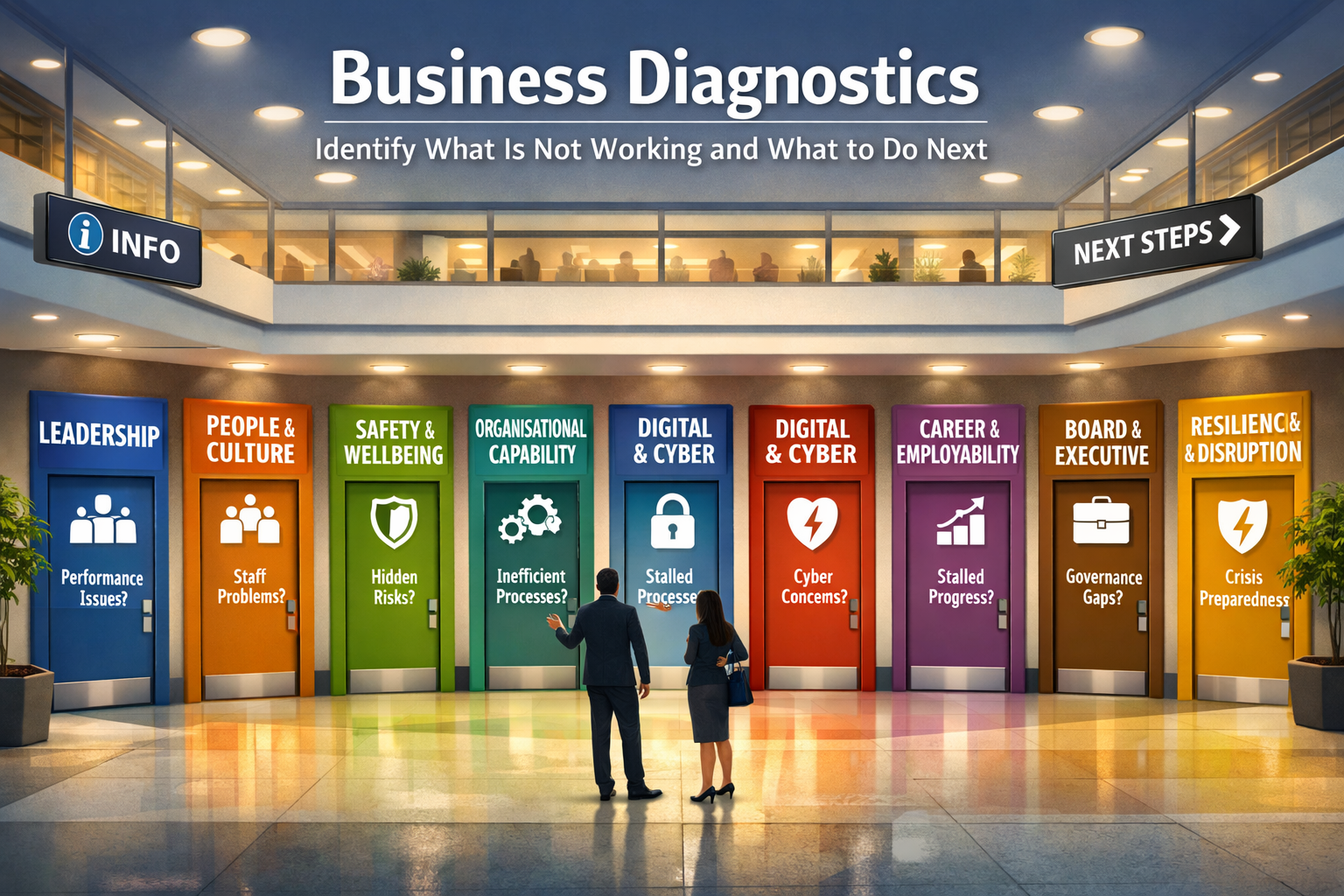
Business Diagnostics — Identify What Is Not Working and What to Do Next
Capability diagnostic tools help you understand where problems exist, why they continue, and what needs to change. Most organisations do not struggle because of effort alone. Instead, pressure builds through unclear leadership, inconsistent systems, and gaps in capability. Over time, this creates frustration, delays, and risk that are difficult to explain. You may already see the signs. Performance feels uneven, decisions take longer than expected, and the same issues continue to return. Because of this, choosing the right starting point becomes critical. This page helps you decide where to begin.
Choose the Area That Reflects Your Current Challenge
Each area represents a different entry point. Therefore, selecting the right one will lead you to the most relevant diagnostics and next steps.
Leadership — When Performance and Accountability Are Inconsistent
Leadership challenges often appear through avoided conversations, unclear expectations, and inconsistent standards. As a result, teams become reactive instead of structured.
People and Culture — When Staff Issues Keep Repeating
People challenges rarely resolve through hiring alone. Instead, they continue when systems, onboarding, and expectations are not aligned.

Safety and Wellbeing — When Risk Is Not Always Visible
Workplace risk often develops quietly through stress, workload pressure, and unclear leadership responses. Consequently, issues surface later than they should.
Organisational Capability — When the Business Feels Inefficient
Effort does not always lead to results. Although teams remain busy, systems and processes may not support consistent performance.

Digital and Cyber — When You Are Not Fully Confident
Cyber risk is often underestimated. However, small gaps in awareness or systems can create significant exposure over time.
Career and Employability — When Progress Feels Unclear
Capability does not always translate into opportunity. In many cases, direction, confidence, or positioning is missing.
Board and Executive — When Oversight Feels Assumed
Governance structures are often in place, although that does not always mean oversight is effective. In many cases, assurance, challenge, or accountability is not as strong as it appears.
Education and Teaching — When Engagement Is Uneven
Learning environments often develop patterns where some individuals engage while others remain overlooked. Awareness is the first step to change.

First Nations — When Cultural Understanding Needs to Go Deeper
Respect often starts with good intent. However, without deeper understanding, it can remain surface level. This creates uncertainty and hesitation in practice.
These diagnostics help you understand where cultural capability sits and how to move from awareness into meaningful action.
Resilience and Disruption — When Performance Is Tested Under Pressure
Organisations often perform well under normal conditions, although disruption exposes how prepared they are to respond, adapt, and continue operating.